
How to Choose HSS Cutting Tools: Types, Materials and Applications
Knowing how to choose HSS cutting tools starts with the operation and workpiece—not a gold, black or bronze surface colour.
Drilling, tapping, reaming and milling load the edge differently. This guide combines tool type, HSS grade, geometry, dimensions and surface option—and explains when carbide may be more economical.
How to Choose HSS Cutting Tools: Quick Selection Table
Define the application before comparing catalog codes or prices. The exact tool maker’s application range and cutting data take priority.
| Selection question | What to confirm | Why it matters |
|---|---|---|
| Which operation? | Drilling, tapping, reaming, milling, countersinking, broaching or profile cutting | Determines the basic tool type and cutting geometry |
| Which workpiece? | Material grade, hardness, heat treatment and abrasiveness | Controls edge strength, hot-hardness and wear requirements |
| Which HSS material? | Conventional HSS such as M2, cobalt-alloyed HSS such as M35 or M42, or a suitable PM-HSS grade | Balances toughness, hot hardness, wear resistance and cost |
| What feature? | Through/blind hole, depth, interruption, profile, tolerance and chip direction | Changes flute, point, chamfer, helix and clearance requirements |
| Which dimensions? | Diameter, length of cut, reach, shank, standard and tolerance | Controls fit, rigidity, access and finished feature size |
| Which surface? | Bright, steam oxide, TiN, TiCN, TiAlN or another validated treatment | Affects friction, adhesion, heat and wear behaviour |
| Which machine? | Manual or CNC, spindle condition, holder, runout, coolant and batch size | Determines whether HSS toughness or carbide productivity adds more value |
Swipe horizontally to view the full table.
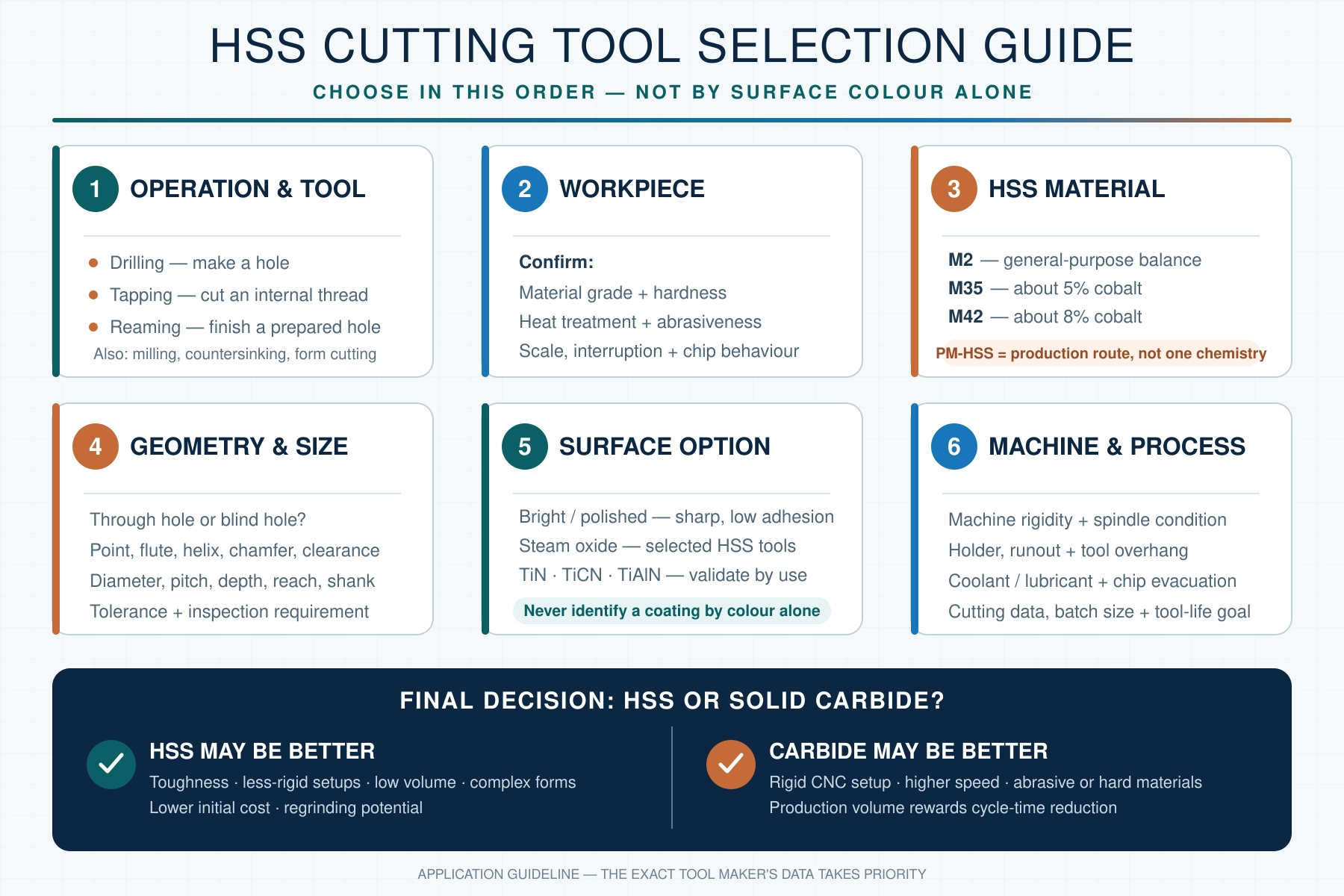
The HSS cutting tool selection process can be grouped into six practical decision areas, as summarized below.
1. Understand What High-Speed Steel Is
High-speed steel is a family of alloy tool steels that retains useful hardness at cutting temperatures. Its alloy system may include chromium, molybdenum, tungsten, vanadium and, in some grades, cobalt.
HSS is the substrate, not a coating. HSS-E and HSCo commonly identify cobalt-alloyed HSS, while PM-HSS identifies a powder-metallurgy production route; exact supplier notation should still be checked. TiN, TiCN and TiAlN are coatings. Steam oxide is a surface treatment, not a PVD coating.
Compared with solid carbide, HSS generally offers greater toughness, lower initial cost and easier production of complex, regrindable forms, but lower stiffness, wear resistance and practical cutting speed.
2. Choose the Correct HSS Cutting Tool Type
First define the operation. A shared substrate does not make different tool types interchangeable.
| Tool type | Typical application | Main selection checks |
|---|---|---|
| Twist and taper-shank drills | Producing holes on manual, conventional and CNC machines | Diameter, depth, point geometry, flute form, shank and chip evacuation |
| Cutting taps | Producing internal threads by chip removal | Thread standard, pitch, tolerance, blind/through hole, chamfer and flute direction |
| Reamers | Finishing a prepared hole for size, geometry and surface finish | Finished limits, pre-hole allowance, lead, flute direction, reach and coolant |
| End mills and slotting cutters | Slots, shoulders, profiles and general milling at moderate cutting speeds | Flute count, helix, centre cutting, reach, chip space and machine rigidity |
| Form, T-slot and gear cutters | Producing a defined profile or difficult-to-reach feature | Exact profile, width, relief, shank/neck clearance and regrinding limits |
Swipe horizontally to view the full table.
HSS is also used for countersinks, centre drills, saws and broaches, as shown in Erasteel’s application range. A forming tap displaces material instead of cutting chips and requires different selection logic.
3. Compare M2, M35, M42 and PM-HSS
Material codes vary by standard and supplier. Confirm the grade on the tool specification or certificate instead of relying on phrases such as “cobalt drill.”
| HSS material | General characteristics | Typical selection logic |
|---|---|---|
| M2 / 1.3343 (for example, HS6-5-2C) | Conventional, general-purpose molybdenum HSS with a balanced combination of toughness, wear resistance and grindability | A practical starting point for general drilling, tapping, reaming, milling and maintenance work |
| M35 / HS6-5-2-5 / 1.3243 | Cobalt-alloyed HSS, nominally around 5% Co, with greater hot-hardness capability than standard M2 | Consider for stainless steel, alloy steel and applications with greater heat or edge-retention demand |
| M42 / HS2-9-1-8 / 1.3247 | Higher-cobalt HSS, nominally around 8% Co, with high hardness, hot hardness and wear resistance | Consider for demanding, harder or heat-generating cuts when the setup still protects the edge from shock |
| PM-HSS (cobalt-free or cobalt-alloyed) | Powder-metallurgy production route with fine, uniformly distributed carbides and reduced segregation; chemistry varies by grade | Use when a premium balance of wear resistance, edge stability and toughness justifies the higher tool cost |
Swipe horizontally to view the full table.
BÖHLER S600 is an M2-type 1.3343 grade for tools including mills, drills and taps. BÖHLER S705 is an M35-type HS6-5-2-5 grade, while Carpenter describes M42 as premium cobalt HSS.
PM-HSS is a manufacturing route, not one chemistry: Erasteel ASP 2023 is cobalt-free, whereas ASP 2030 is cobalt-alloyed. Carpenter’s Micro-Melt M42 demonstrates the refined carbide distribution and reduced segregation possible with PM production. Dormer Pramet, for example, describes a cobalt powder-metal end mill as HSS-E PM; always confirm supplier notation.
4. Match the HSS Grade to the Workpiece Material
When learning how to choose HSS cutting tools, treat the workpiece designation as the starting point, not the complete answer. The substrate designation alone does not determine application suitability: hardness and heat treatment, tool geometry, edge preparation, coating, cutting data, inclusions, scale, interruption and chip behaviour must be evaluated together.
| Workpiece group | Possible HSS starting point | What requires attention |
|---|---|---|
| Low- and medium-carbon steel | M2 for general work; M35 or coated HSS for higher duty | Chip control, edge build-up, hole depth and lubrication |
| Alloy and pre-hardened steel | M35, M42 or a validated PM-HSS series | Actual hardness, heat, edge strength and whether carbide is more productive |
| Austenitic stainless steel | Cobalt-alloyed HSS or an application-specific PM-HSS grade with stainless-steel geometry | Work hardening, rubbing, chip evacuation, low runout and effective lubricant delivery |
| Aluminium and non-ferrous alloys | Sharp bright or polished HSS; coating only when validated for the alloy | Material adhesion, flute polish, chip space and avoiding built-up edge |
| Titanium and nickel-based alloys | M42 or PM-HSS for suitable low-speed or special-form applications | Heat concentration, tool pressure, lubrication and whether carbide offers a safer production window |
Swipe horizontally to view the full table.
Abrasion and hardness can move cast-iron or hardened-material applications toward carbide. These are starting directions, not universal assignments: two M35 tools may have different geometry, heat treatment and application ranges.
5. Match Geometry to the Application
Geometry can matter more than grade. Confirm how the tool enters, forms chips and exits the cut.
HSS drills
Choose the shortest drill that reaches the full depth. Stub drills add rigidity; long drills trade rigidity for access. Split points can reduce thrust, while parabolic flutes may improve chip evacuation. Compare Dormer Pramet’s bright jobber drill with Guhring’s extra-length parabolic HSS drill series: they solve different conditions.
HSS cutting taps
A spiral-point tap commonly drives chips ahead through a through hole; a suitable spiral-flute tap commonly lifts chips back out of a blind hole. OSG identifies spiral-point taps for through-hole applications ve spiral-flute taps for blind-hole applications. Straight-flute and material-specific designs remain valid alternatives.
Reamers, milling cutters and form tools
A reamer finishes a controlled pre-hole; it does not reliably correct position error. Select it from finished limits, allowance and chip direction; see our reamer selection guide. For end mills and form cutters, confirm flute count, helix, neck clearance and profile. All else being equal, more flutes leave less chip space.
6. Check Size, Reach, Shank and Tolerance
A suitable grade can still fail if the dimensions are incomplete. Prepare the applicable standard and working dimensions:
- Cutting diameter or thread size and pitch
- Tool tolerance and required finished-feature limits
- Cutting length and full working depth
- Overall reach, flute length and bottom clearance
- Straight, reduced, three-flat or Morse-taper shank
- Neck diameter and holder/fixture clearance
- Cutting direction and DIN, ISO, ANSI or drawing standard
Use extra length only when required. Our extra-long HSS taper-shank drill illustrates one format, but no substrate can compensate for excessive overhang. For carbide applications, see our solid carbide drill selection guide.
7. Choose the Surface Finish, Treatment or Coating
The surface option completes HSS tool selection; it cannot replace the right substrate and geometry. Bright or polished surfaces, oxide treatments and PVD coatings are different categories. Follow the tool maker’s application data, not colour alone.
| Surface option | General role | Selection caution |
|---|---|---|
| Bright / uncoated / polished | Sharp edge and low-friction chip surface; often useful for soft or adhesive materials | “Uncoated” does not mean universal; geometry and polish must suit the application |
| Steam oxide / supplier-specified black oxide | Oxide treatment used on selected HSS tools to improve lubricant retention or mechanical lubricity and help reduce adhesion | It is not a PVD hard coating; the exact process and application range vary by supplier |
| TiN | Versatile wear protection against abrasive and adhesive wear | Confirm the exact workpiece and cutting temperature |
| TiCN | High wear resistance and relatively low friction; commonly considered for tapping and some moderate-speed milling | Less suited to high-heat applications than TiAlN-type coatings |
| TiAlN / related heat-resistant coatings | Thermal and wear resistance for highly stressed ferrous-material applications | Verify that the specific coating is approved for the HSS substrate and operation |
Swipe horizontally to view the full table.
Guhring’s guide positions TiN as versatile wear protection, TiCN for tapping and moderate-speed wet milling, and TiAlN for thermally stressed HSS and carbide tools. OSG states that steam oxide can increase mechanical lubricity on an HSS-E tap. Identify any bronze-coloured surface from the supplier’s specification; colour does not prove its chemistry. After regrinding, confirm whether recoating is required.
8. Decide When HSS or Solid Carbide Is the Better Choice
Good selection also recognizes when HSS is no longer economical. Compare total process cost, not only purchase price.
| HSS may be preferable when | Solid carbide may be preferable when |
|---|---|
| The setup is less rigid or includes manual/conventional machines | The CNC machine, holder and workpiece provide high rigidity and low runout |
| Shock resistance and edge toughness are more important than maximum speed | Wear resistance, stiffness and higher cutting speed drive productivity |
| Batch size is low, the tool is used intermittently, or initial cost matters | High production volume makes cycle time and predictable tool life more valuable |
| The application benefits from a very sharp, regrindable cutting edge | The material is abrasive, harder or better served by a carbide grade/coating |
Swipe horizontally to view the full table.
Kennametal’s drill comparison distinguishes cobalt HSS by heat resistance and carbide by rigidity and production capability. The boundary still depends on diameter, depth, machine condition and tool design.
9. Set Cutting Data, Coolant and Toolholding
Use cutting data for the exact diameter, grade, coating and workpiece. Do not copy one speed across different tool types.
- Drills: confirm cutting speed, feed per revolution, depth strategy and chip evacuation.
- Cutting taps: synchronize feed to thread pitch and use a suitable tapping holder or rigid cycle.
- Reamers: use controlled allowance, continuous feed and the tool maker’s speed/feed range.
- End mills and form cutters: use feed per tooth, radial/axial engagement and an appropriate entry strategy.
Keep overhang short, check runout and direct fluid to the cut. With work-hardening materials, low feed, dull edges or poor evacuation can cause damaging rubbing. If a coated tool chips, check impact, alignment and geometry before choosing a harder coating.
10. Avoid Common HSS Tool Selection Mistakes
- Do not identify a coating by colour; confirm its name and application range.
- Do not treat cobalt as a coating; verify the M35, M42 or other substrate grade.
- Do not assume M42 is always best; balance heat/wear demand against shock and cost.
- Do not buy unnecessary length; use the shortest tool that reaches safely.
- Do not ignore blind/through chip direction or use one universal cutting speed.
- Do not compare HSS and carbide only by purchase price; include cycle time and parts per edge.
11. How to Choose HSS Cutting Tools: Final Checklist
Prepare the following information before requesting a recommendation or quotation:
- Operation and required feature
- Tool type and dimensional standard
- Diameter, pitch, profile or included angle
- Cutting length, working depth and overall reach
- Tolerance, finish and inspection method
- Through, blind, interrupted or deep feature
- Workpiece grade, hardness and heat treatment
- Machine, spindle, holder and estimated runout
- Coolant or lubricant method
- HSS grade, coating, current data and failure mode
- Order quantity and regrinding plan
A reliable process follows this sequence: operation → feature and dimensions → workpiece → geometry → HSS grade → surface treatment → machine and cutting data → inspection and tool-life review.
Sıkça Sorulan Sorular
Is cobalt HSS the same as a cobalt coating?
No. In M35 and M42, cobalt is an alloying element distributed through the HSS substrate. It is not a surface layer and remains present after regrinding.
Should I choose M35 or M42?
M35 often balances performance and toughness for stainless and alloy steels. M42 offers greater hardness and hot-hardness capability but is not automatically best in an unstable or impact-prone setup. Compare the exact tool series.
Is PM-HSS a specific steel grade?
No. PM-HSS describes a powder-metallurgy production route. Different PM-HSS tools can have different chemistries, hardness levels and application ranges.
What is the best coating for HSS cutting tools?
There is no universal best option. TiN, TiCN, TiAlN, steam oxide and bright finishes address different friction, adhesion, wear and heat conditions. Follow the exact tool maker’s data.
When should I replace HSS with carbide?
Consider carbide when rigidity and volume reward higher speed, or hardness and abrasion exceed the practical HSS range. HSS may remain preferable for shock, low volume, manual work or complex regrindable forms.