
ดอกกัดขึ้นรูปสั่งทำสำหรับอลูมิเนียม: 2 กรณีตัวอย่างงานกัดร่อง T
Need a custom form cutter for aluminum that can produce a special slot profile in one cutting pass?
Standard T-slot cutters and end mills work well for common profiles. But non-standard grooves, stepped sections and restricted tool access may require a custom solid carbide form cutter matched to the component drawing.
HY Cutting Tools completed two custom T-slot form cutter projects for aluminum machining. Both cutters were manufactured to different profile specifications and tested by the customer. According to customer feedback, both produced the required profiles in a single form-cutting pass and met the machining requirements.
รายชื่อบท
Why Use a Custom Form Cutter for Aluminum?
A form milling cutter has a cutting profile designed to generate a specific feature on the workpiece. Rather than machining every step, radius or shoulder separately, the form tool can generate the required cross-section during a controlled cutting pass.
For special aluminum T-slots, three requirements are particularly important:
- Profile matching: The cutting profile must be specified to generate the required slot widths, steps and radii along the intended toolpath.
- Tool clearance: The neck and shank must clear adjacent surfaces while the cutting head reaches the undercut area.
- One-pass forming: Cutter geometry, material allowance and machining conditions must suit the intended form-cutting pass.
A T-slot form cutter has an enlarged cutting head relative to its neck, allowing it to reach beneath the slot opening and machine recessed side features.
What “one pass” means here: It refers to the profile-forming pass. The tool still needs a suitable entry path, sufficient clearance and an appropriate amount of material to remove; access or roughing operations may be separate.
Case 1: Precision T-Slot Form Cutter with a Reduced Neck
The first project involved a custom four-flute solid carbide T-slot cutter with a relatively small cutting head and reduced-neck geometry.
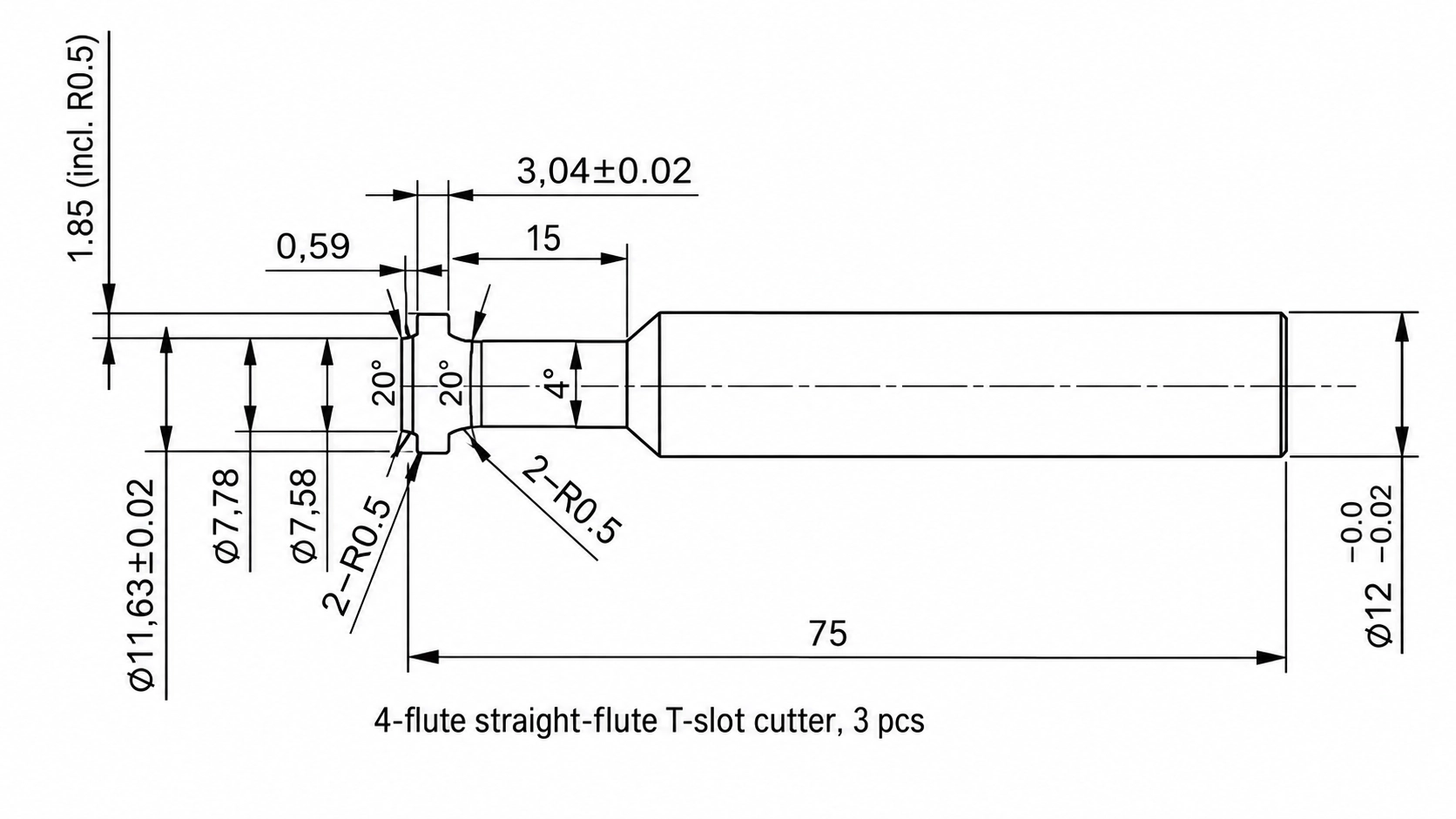
Custom Tool Specifications
Selected tool-drawing specifications. The approved drawing defines the complete geometry and tolerances.
Finished Tool Video
Machining Challenge and Solution
The required cutter head was wider than the neck, creating a T-shaped profile for side cutting within a restricted slot. The cutting head needed to match the specified profile while the neck provided clearance behind the cutting edges.
The Ø11.63 mm head and 3.04 mm axial width defined important parts of the custom geometry. The neck diameters, transition radii and head-to-shank distance also needed to be considered together when checking tool access.
Case 2: Custom Stepped T-Slot Form Cutter for Aluminum
The second project required a larger cutting head with a stepped profile. The drawing below shows the cutter in its holder, with the head dimensions and axial references used to define the profile.
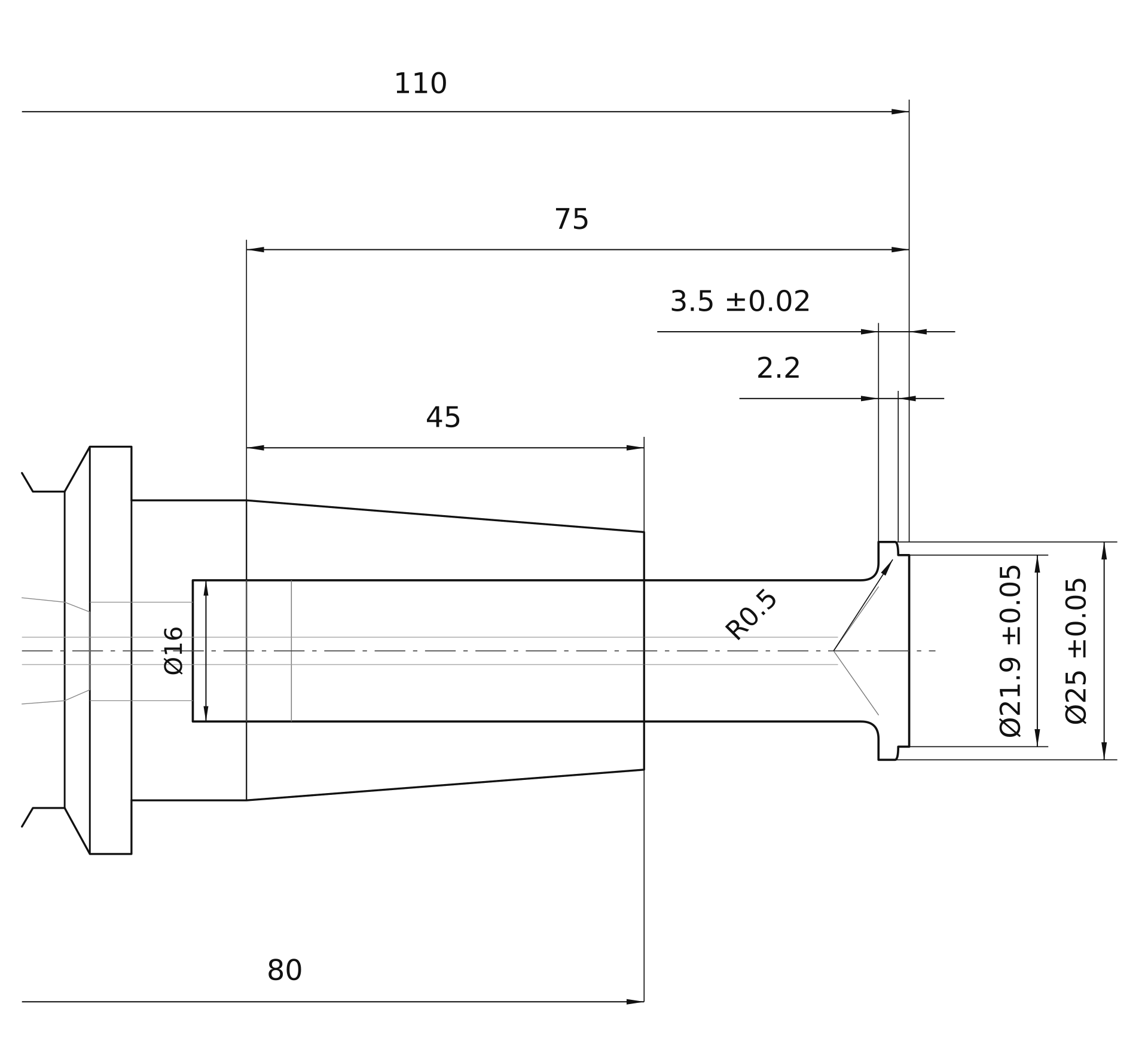
Custom Tool Specifications
The 3.5 mm and 2.2 mm axial dimensions share the same rear reference face; they should not be added together. Assembly reference lengths are separate from these head dimensions.
Finished Tool Video
Machining Challenge and Solution
This cutter required a stepped cutting profile rather than a single uniform cutting diameter. The profile needed to reproduce multiple features with the specified axial positions and diameter relationships.
Integrating these features into one cutting head allowed the required profile to be formed in a single pass under the customer’s machining conditions. Tool access, neck clearance and cutter rigidity remained important checks for the larger head.
How One-Pass T-Slot Form Milling Works
The cutting profile and programmed toolpath work together to generate the intended workpiece feature. In a suitable machining process, the operation follows three basic stages:
- Prepare access. Provide the entry slot or other clearance needed for the cutting head.
- Position the form cutter. Check that the head can reach the target location without neck, shank or fixture interference.
- Form the profile. Move the cutter along the programmed toolpath with a suitable allowance for the form-cutting pass.
The actual material allowance, feed, spindle speed, coolant method and toolpath must be selected for the aluminum grade, cutter geometry and machine setup.
For general guidance on tool selection, rigidity and chip evacuation, see Sandvik Coromant’s groove or slot milling guide.
Manufacturing Challenges and Quality Requirements
For these two projects, important drawing requirements included head diameters, axial widths, stepped features, radii and neck geometry. Four areas deserve particular attention.
1. Profile Grinding Accuracy
The cutting head must match the approved tool drawing. Errors in diameter, width or radius can affect the final slot geometry.
2. Neck Clearance and Tool Rigidity
A reduced neck allows the cutting head to reach undercut features, but neck length and diameter must also provide adequate strength for the intended cut. Clearance and rigidity need to be checked together.
3. Cutting Geometry for Aluminum
Sharp cutting edges, chip clearance and suitable lubrication are important when machining aluminum. Final edge preparation and surface treatment should be selected according to the aluminum grade and cutting conditions.
4. Drawing-Based Inspection
Critical profile dimensions and tolerances need to be verified against the approved tool drawing. Tool-manufacturing tolerances and finished-part tolerances should be distinguished; the machined groove also depends on runout, tool deflection, positioning and the cutting process.
Learn more about HY Cutting Tools’ manufacturing and quality control process.
Customer Feedback: One-Pass Machining Requirements Met
After using the tools, the customer reported that both the Ø11.63 mm cutter and the Ø25 mm stepped cutter produced the required profiles in a single form-cutting pass and met the machining requirements.
About the videos: They show the drawings and finished cutter geometries. The machining result above is based on customer feedback.
Custom Form Cutter Manufacturing and Repeat Orders
For buyers sourcing custom form cutters for aluminum, repeat production depends on maintaining the approved profile, dimensional tolerances and cutting geometry.
HY Cutting Tools supports drawing-based custom tooling, small trial quantities and repeat-order manufacturing. The approved drawing revision and agreed inspection requirements should be retained as references for subsequent orders.
Available customization can include cutter-head dimensions, stepped profiles, radii, neck relief, shank configuration, flute geometry and suitable surface treatments, subject to technical review.
มาค้นพบ custom cutting tool manufacturing capabilities.
คำถามที่มักถูกถาม
Can a custom form cutter machine an aluminum T-slot in one pass?
It can when the cutting profile, tool access, material allowance and machining conditions are suitable. In these two projects, the customer reported that the required profiles were achieved in one form-cutting pass. Any necessary access or roughing operation is a separate consideration.
What is the difference between a standard T-slot cutter and a custom form cutter?
A standard T-slot cutter has a catalog-defined head diameter and cutting width. A custom form cutter can use drawing-specific diameters, axial dimensions, steps, radii and neck clearance when the available standard geometry does not fit the application.
Can a single solid carbide cutter combine several profile features?
Multiple steps, diameters and radii can be integrated into one form-cutting head, as illustrated by Case 2. Whether they can be machined together depends on tool access, the amount of material to remove, cutter strength and the machining setup.
Can I send a part drawing if I do not have a tool drawing?
Yes. Send the slot cross-section or component drawing, identify the critical tolerances, and show how the tool can enter the feature. HY Cutting Tools can review what additional tool and application details need to be confirmed.
What information is needed to manufacture a custom aluminum form cutter?
Start with the part drawing, tool drawing or reference sample. Include the aluminum grade, critical dimensions and tolerances, machining depth, entry clearance, tool-holding requirements and quantity. If you are sourcing for a customer, confirm which dimensions are part requirements and which belong to an existing tool.
คู่มือที่เกี่ยวข้อง


ต้องการทราบขนาด ราคา หรือตัวเลือกการปรับแต่งตามความต้องการหรือไม่?
Send us the tool sizes, workpiece material and quantity. For a custom tool, include the key dimensions or describe the feature you need to machine.