
Why Do Similar Aluminum End Mills Perform So Differently?
You buy two Ø6 mm, 3-flute aluminum end mills. On paper, they look almost identical: 35° helix, square end, uncoated, same CEL, same SHK, same OAL.
But once they are on the machine, the difference can show up fast. One tool may evacuate chips cleanly, resist aluminum buildup, hold a stable finish, and wear predictably. The other may start sticking, packing chips, recutting, leaving burrs or chatter marks, or wearing one flute much faster than the others.
The harder problem is inconsistency. A first sample may cut very well, but other tools from the same batch do not repeat that result.
Once machine, holder, workholding, material, and cutting conditions are controlled, the difference is more likely to come from the tool itself — not just D, CEL, SHK, or OAL, but from cutting geometry, edge condition, runout, and manufacturing consistency.
Same nominal specifications do not automatically mean the same cutting performance.
Why Do Similar Aluminum End Mills Perform Differently?
Diameter, cutting length, shank diameter, overall length, flute count and nominal helix describe only part of the tool. Core size, rake, relief, edge preparation and flute finish can still differ.
The tools may have different design priorities. A geometry that suits side milling may struggle in a deep slot. Check application fit before judging manufacturing quality.
First rule out mounting, material and cutting-condition changes. If the difference persists, compare several tools for edge condition, geometry, runout and lot variation.
Confirm the operation, run a documented comparison, and check more than one sample. Approval should cover the agreed machining result and repeat-order requirements.
If Two Tools Perform Differently, What Should You Check First?
The machining symptom usually gives the first clue about where to look, although it does not prove that the tool itself is the root cause.
| What You See | Check First |
|---|---|
| Aluminum buildup / built-up edge | Edge condition, flute surface finish |
| Chip packing / recutting | Core & flute geometry, chip evacuation |
| Chatter | Runout, overhang, system rigidity |
| Early micro-chipping | Substrate, edge geometry, runout |
| Performance varies from tool to tool | Grinding consistency, batch consistency |
If aluminum buildup is the main symptom, see our detailed guide on aluminum sticking to end mills .
1. Carbide Substrate Affects Edge Retention and Wear Behavior
Solid carbide end mills can use different substrate grades. For aluminum machining, the balance matters more than hardness alone.
- Edge Retention
- Toughness
- Wear Stability
- Micro-Chipping Resistance
The substrate must retain a sharp edge under vibration and interrupted loading. Excessive brittleness can cause early chipping; poor edge retention leads to faster dulling.
“Solid carbide” alone does not tell you how well the edge will hold or how predictably the tool will wear.
2. Cutting-Edge Condition Changes How Cleanly the Tool Cuts
Similar tool geometry can hide differences in edge sharpness, radius, grinding marks, micro-chipping, and burrs. An insufficiently sharp edge can rub instead of cutting cleanly, leading to:
- More cutting resistance
- More aluminum adhesion
- Earlier burr formation
- Faster finish deterioration
Compare edge condition across several tools of the same specification; a sharp-looking product photo cannot confirm consistency.
3. Core Diameter and Flute Geometry Balance Rigidity and Chip Space
Two tools can both be 3-flute, 35° helix, and the same diameter, yet still have different core diameters, flute depths, gullet volumes, and flute transitions.
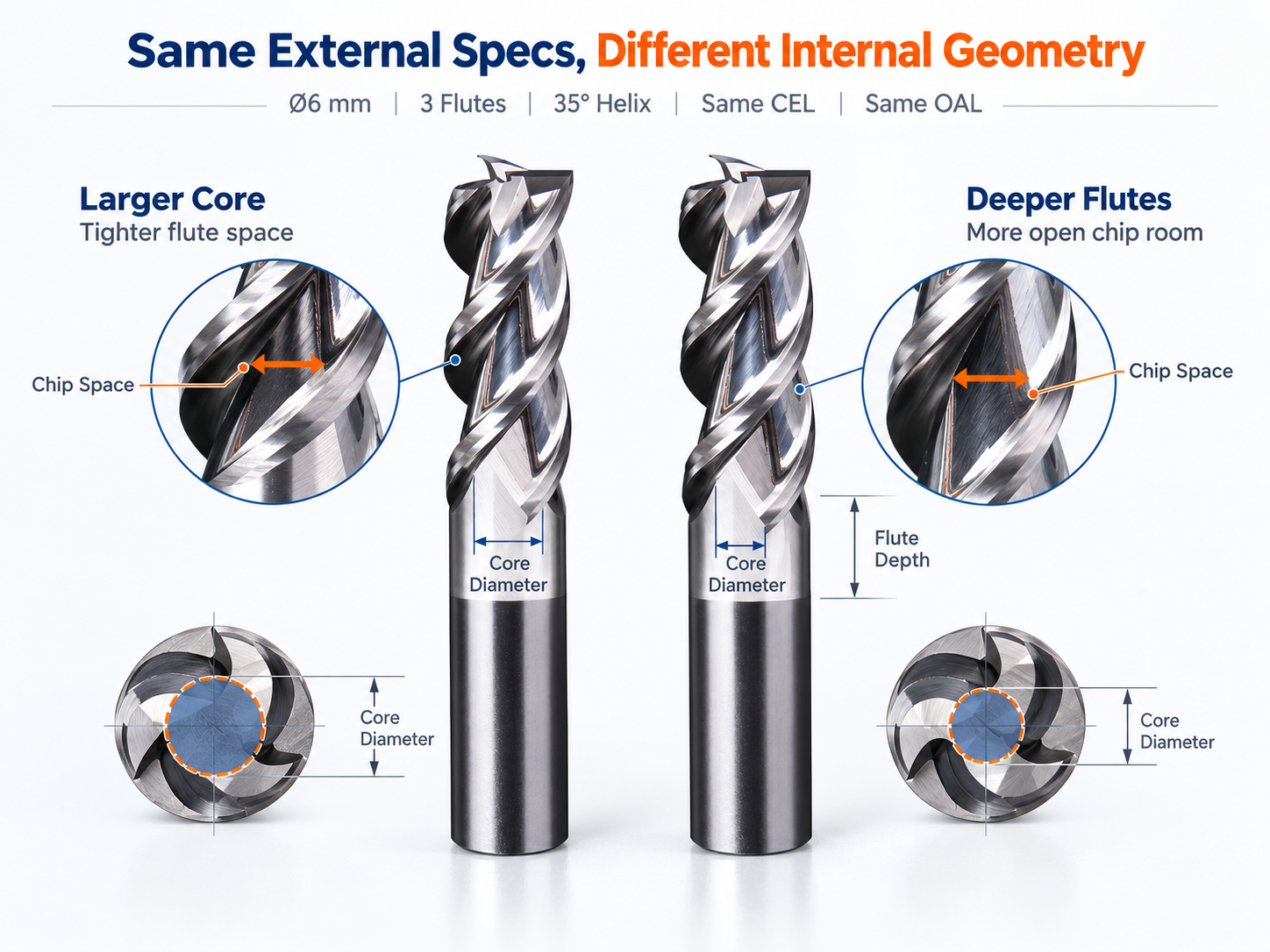
Higher rigidity and section strength, but less available space for chips.
Better chip capacity and evacuation, but potentially lower section rigidity.
This trade-off becomes especially important in full slotting, deep pockets, or heavier material removal, where chip volume is much higher than in light side milling.
The better question is not simply whether a 3-flute tool is “good for aluminum,” but whether its core and flute geometry suit the actual operation.
For background on flute count, helix angle and application selection, see Harvey Performance’s aluminum machining guide. Use the guidance alongside your customer’s alloy, operation and the tool supplier’s cutting data.
4. Rake Angle and Relief Geometry Affect Cutting Resistance and Edge Strength
A 35° helix does not tell you the rake or relief geometry. These are separate design features that affect how freely the tool cuts and how much support remains behind the cutting edge.
A more positive rake can help reduce cutting resistance and improve chip formation in aluminum. But if edge support becomes too weak, the tool may become more sensitive to vibration and micro-chipping.
Relief geometry has a similar balance. Too little clearance increases rubbing and heat, while excessive relief can reduce support behind the cutting edge.
5. Flute Surface Finish Affects Chip Flow and Aluminum Adhesion
Many aluminum end mills are described as having “mirror-polished flutes.” But brightness alone does not tell you whether chips will actually move smoothly through the flute.
Grinding marks, local roughness, or uneven transitions can increase friction and give aluminum more opportunity to stick. Once chips start adhering, available flute space decreases and recutting increases.
A flute can look highly polished in a photo and still perform poorly if the surface condition does not support clean chip flow.
6. Cutting-Edge Runout Changes How Much Work Each Flute Actually Does
On a 3-flute end mill, the cutting load should be shared reasonably evenly. If one cutting edge runs farther out than the others, that flute ends up doing more of the work.
The result can be uneven wear, premature chipping, periodic surface marks, dimensional variation, and shorter tool life.
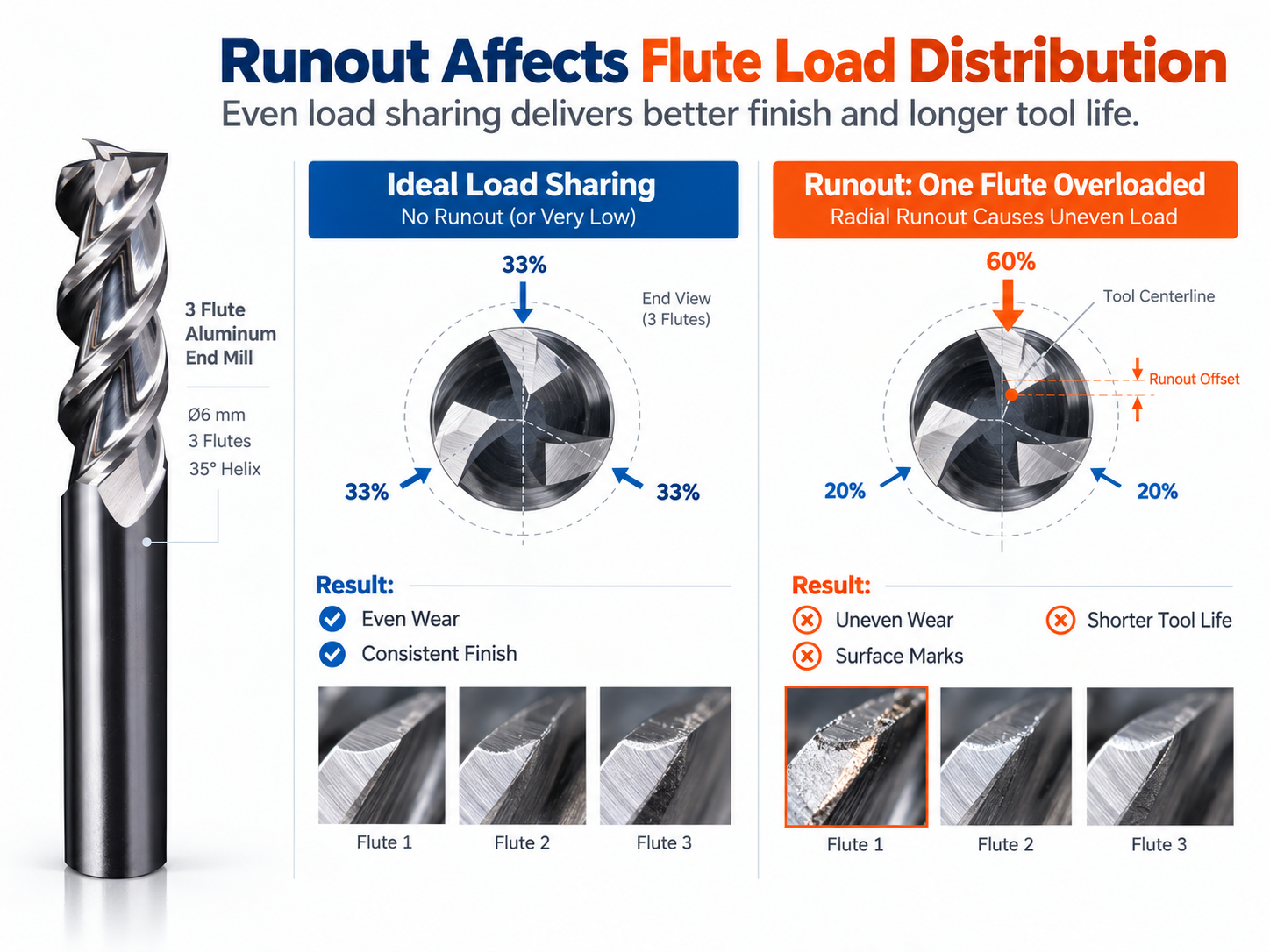
Variation coming from the cutting edges or the tool itself.
Can come from the holder, collet, spindle, tool shank, contamination, or clamping.
Test principle: Keep the machine, holder, clamping method, overhang and system runout comparable when testing suppliers.
Runout should be checked at the cutting location, using a method appropriate for the tool’s size and geometry. Harvey Performance’s guide to reducing tool runout explains measurement considerations and the contribution of the holder, collet and spindle.
7. Grinding Consistency Determines Tool-to-Tool Repeatability
A good sample proves that one tool can cut well. It does not prove that every tool of the same specification will behave the same way.
Grinding consistency is about whether multiple tools can repeat the same cutting-edge geometry, flute geometry, rake and relief geometry, runout, and surface condition.
Shows that one individual tool can meet the application.
Shows whether the manufacturing process can repeat the same result.
For long-term purchasing, tool-to-tool repeatability is more valuable than one unusually good sample.
8. Batch Consistency Determines Whether Good Samples Carry Into Future Orders
Tool-to-tool repeatability looks inside the current batch. Batch consistency asks a bigger question: can the next production lot repeat the approved result?
| Verification Step | What to Check |
|---|---|
| Retain Approved Sample | Use it as the reference for future production lots |
| Record Lot Numbers | Keep variations traceable to specific batches |
| Check Critical Dimensions | Diameter, CEL, shank diameter, cutting-edge runout |
| Compare Edge & Flute Condition | Check against the approved sample |
| Compare Machining Results | Chip evacuation, surface finish, wear, tool life |
| Watch Repeat Orders | Confirm later lots continue to repeat the approved result |
The real question is whether the approved result can be repeated in the next batch and future orders.
For more information about manufacturing and inspection controls, see our التصنيع والجودة process.
How to Compare Two Similar Aluminum End Mills Fairly
The goal of sample testing is not only to identify which tool cuts better. It is to determine whether that result is repeatable under controlled conditions.
Match the Tool Specifications.
Compare tools with the same or clearly comparable diameter, CEL, SHK, OAL,
flute count, end profile, coating condition, and target application.
Keep the Machining Conditions Stable.
Use the same machine, holder, overhang, aluminum grade, RPM, feed,
axial depth, radial engagement, and coolant or air-blast conditions as far as possible.
Compare Results That Actually Matter.
Look beyond whether the tool survives.
Compare chip evacuation, aluminum adhesion, surface finish, tool life,
edge wear, chipping, dimensional stability, and cutting stability.
Do Not Stop at One Sample.
A practical validation path is:
single sample → multiple samples → small trial order → repeat order.
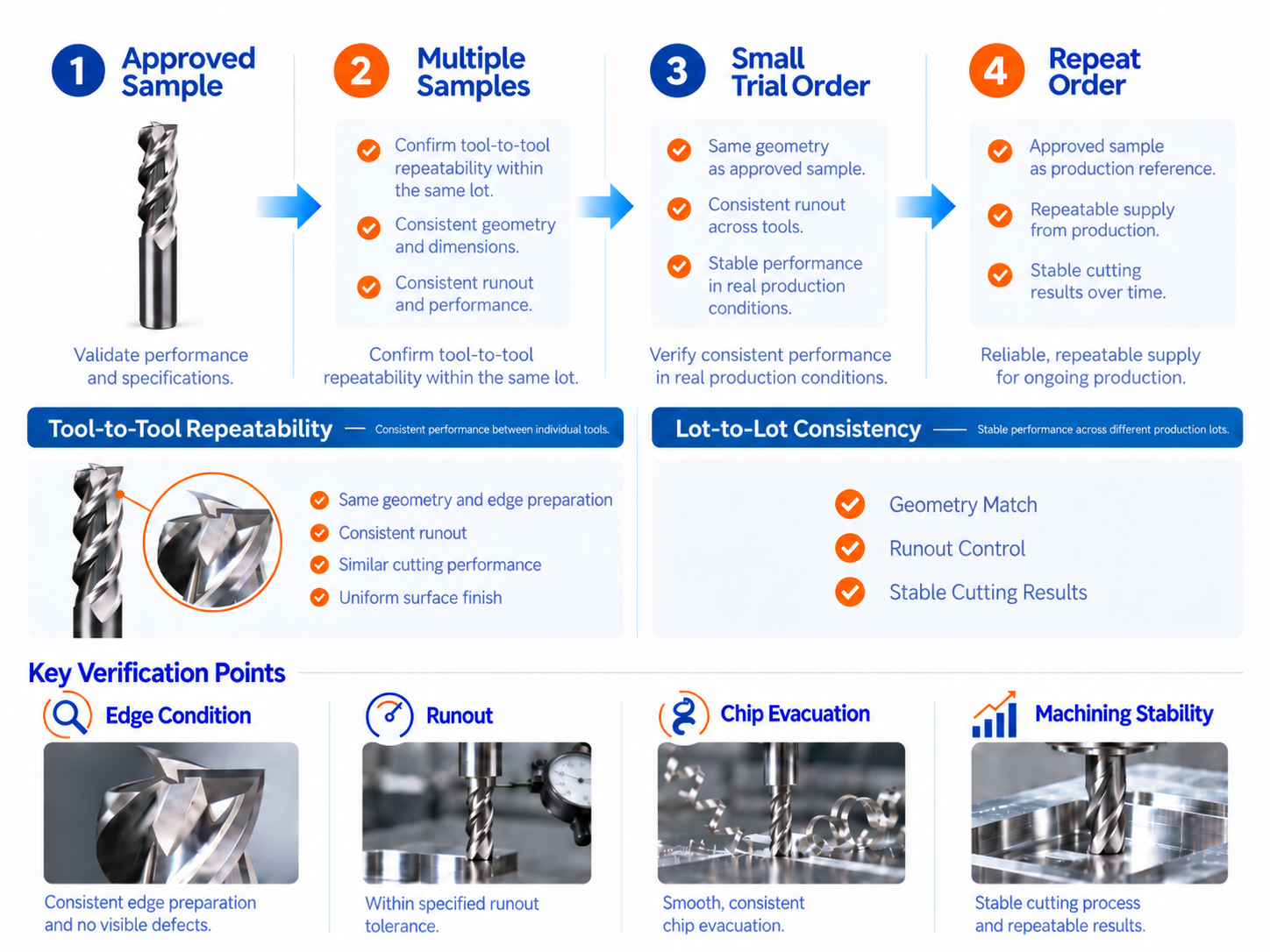
Change one major variable at a time. Otherwise, you may be comparing the setup instead of the tool.
Compare Cost per Part, Not Just Unit Price
Unit price is easy to compare, but it is not the same as machining cost.
The USD 8 tool looks cheaper initially. But shorter tool life, more buildup, extra tool changes or unstable batches can make its real cost per part higher.
- Tool life
- Tool-change frequency
- تشطيب السطح
- Breakage risk
- Batch consistency
- Delivery stability
The lowest tool price does not automatically produce the lowest machining cost.
Buyer Checklist Before Approving a Supplier
| Area | What to Confirm |
|---|---|
| Tool Performance | Chip evacuation, buildup, finish, tool life, abnormal wear |
| Tool-to-Tool Consistency | Multiple-sample performance, edge condition, runout |
| Test Validity | Same machine, holder, overhang, material, and cutting conditions |
| Repeat Supply | Lot-to-lot stability, traceability, repeat-order performance |
| Commercial Result | Cost per part, complaint risk, delivery stability |
For distributors and private-label buyers, the same approval logic also applies to OEM & Private Label cutting tool programs .
The real question is not “Is this sample good?” but “Can this supplier repeat the result consistently?”
الأسئلة الشائعة
Why do two aluminum end mills with the same specs perform differently?
Because dimensions, flute count, and nominal helix angle describe only part of the tool. Substrate, edge condition, internal geometry, flute finish, runout, and manufacturing consistency can all change cutting behavior.
Does a mirror-polished flute actually make a difference in aluminum?
Yes. A good flute surface can reduce friction and aluminum buildup, but brightness alone does not prove good machining performance.
Can runout make a good tool perform badly?
Yes. Excessive runout can overload one flute and cause uneven wear, premature chipping, surface marks, and shorter tool life.
Why can similar aluminum end mills have very different prices?
Price differences can come from carbide substrate, grinding accuracy, edge quality, flute surface condition, inspection, and batch control.
How many samples should I test before approving an aluminum end mill supplier?
There is no single sample count for every application. Test multiple tools of the same specification under comparable conditions, then verify the results through a small trial order and a later production batch. Agree on the sample quantity and acceptance criteria based on your application risk and order volume; one successful sample alone does not demonstrate repeatability.
How can I tell whether a good sample represents future bulk orders?
Test more than one tool, then verify lot-to-lot consistency through trial orders and repeat orders.
What is the most important rule when comparing two suppliers?
Change only the tool itself as much as possible and keep machine, holder, material, parameters, and cooling conditions comparable.
Same Specs Do Not Guarantee the Same Cutting Performance
Two aluminum end mills can share the same diameter, cutting length, shank diameter, flute count, and nominal helix angle — and still cut very differently.
The difference may come from carbide substrate, cutting-edge condition, core and flute geometry, rake and relief geometry, flute surface finish, runout, grinding consistency, and batch consistency.
For buyers, the goal is not simply to find one sample that cuts well. It is to verify whether that result can be repeated from one tool to the next, from one batch to the next, and from the first trial order to future repeat orders.
That is the difference between a good sample and a reliable supply program.
Need Samples for an Aluminum End Mill Trial?
Send your current tool specification, aluminum grade and machining operation. Include the sample quantity and expected repeat-order volume so we can review suitable options for your trial.
Request a Sample Quote