Custom R2 Lollipop End Mill: Build-to-Print Case Study
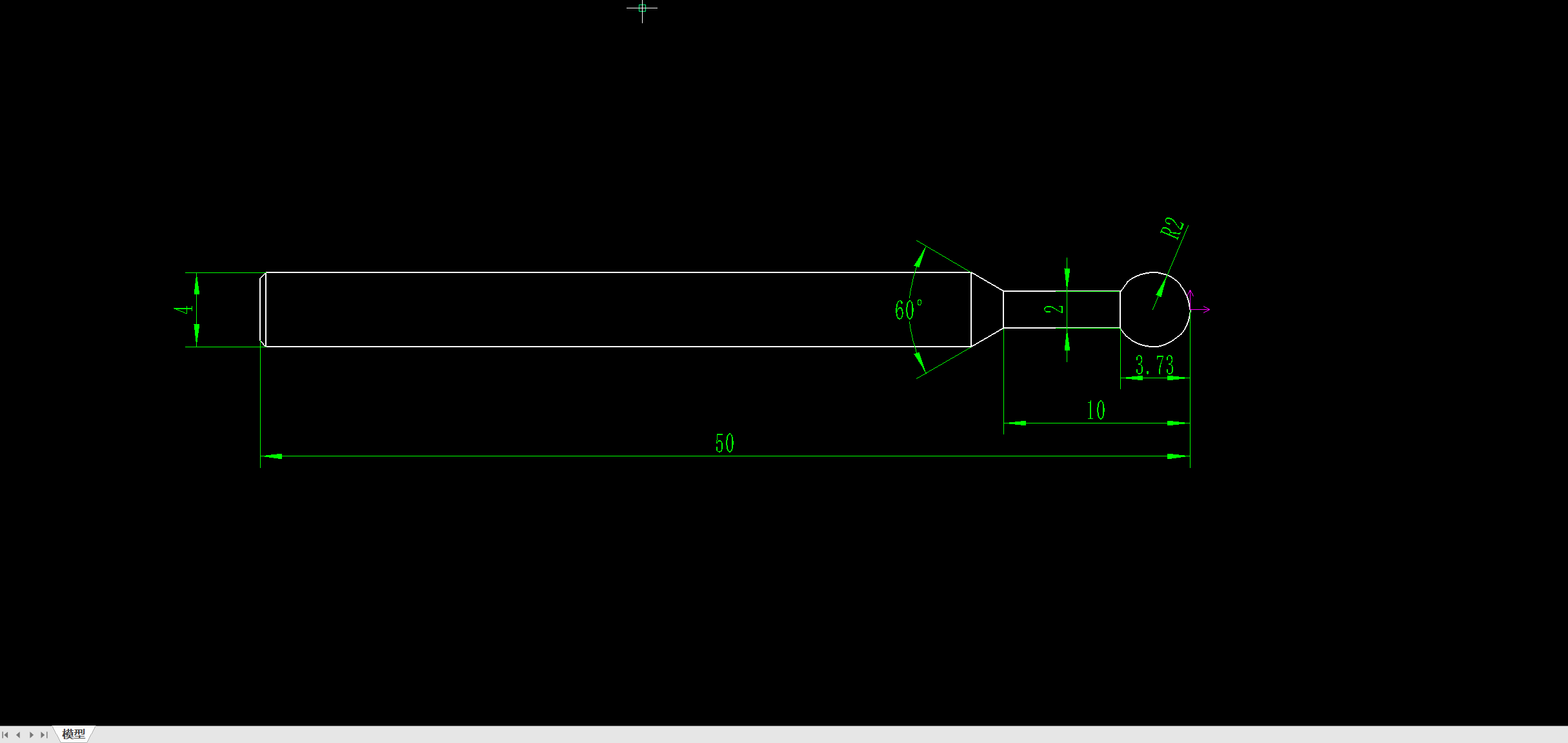
This custom R2 lollipop end mill features a reduced-neck design to improve cutting-head access to recessed and undercut surfaces while reducing the risk of neck interference. Manufactured by HY Cutting Tools according to a customer-supplied drawing, the finished cutter features an R2 spherical head, Ø2 mm reduced neck, Ø4 mm shank, and 50 mm overall length. The customer-specified 60° tapered transition completes the geometry; manufacturing was completed to the customer’s requirements, with the actual finished cutter shown below.
01Customer Requirement & Project Scope
The customer supplied a finalized drawing specifying the spherical cutting head, reduced-neck profile, shank dimensions and transition geometry. HY Cutting Tools’ role was to manufacture the defined cutter, rather than independently design or optimize its geometry.
The drawing includes a 10 mm front-end dimension. This should not automatically be interpreted as the length of the straight reduced-neck section without checking the drawing datums. The customer’s exact workpiece and machining setup were not documented in the available project materials.
02Tool Geometry & Engineering Considerations
| Drawing feature | Specified requirement |
|---|---|
| Spherical Head Radius | R2 |
| Nominal Spherical Head Diameter | Ø4 mm |
| Reduced-Neck Diameter | Ø2 mm |
| เส้นผ่านศูนย์กลางของชังค์ | Ø4 mm |
| ความยาวรวม | 50 mm |
| Front-End Dimension | 10 mm (drawing-defined) |
| Tapered Transition | 60° |
| Manufacturing Approach | Build-to-print |
Spherical Head & Wrap Angle
An R2 head corresponds to a nominal Ø4 mm spherical profile. That profile does not, by itself, establish the cutting-edge wrap angle. Whether the cutter has a 220°, 270° or 300° cutting configuration must be determined from its actual cutting-edge design.
Reduced-Neck Clearance
The Ø4 mm head and Ø2 mm neck have a nominal 1 mm difference between their radial envelopes. This may improve access behind the spherical head, but it is not a guaranteed workpiece clearance. Actual clearance depends on the part, tool orientation and full toolpath.
60° Transition
The tapered transition is a customer-specified feature. Because the design rationale was not documented, the 60° value should not be presented as a validated stiffness or clearance optimization.
03Relevant Undercutting Applications
Reduced-neck lollipop cutters are commonly considered for recessed curved profiles, undercuts beneath shoulders, reverse-facing contours, restricted-access finishing and certain underside deburring operations. Whether the cutting edge can reach a particular surface depends on its actual wrap angle, tool orientation and collision clearance.
These are general applications of this cutter type, not verified machining operations performed with this specific customer tool. For product configurations, see our Solid Carbide Lollipop Ball Nose End Mills R1–R10 for Steel and Aluminum.
If you are still choosing between cutting-head diameters, 220°, 270° and 300° wrap angles, or different neck and reach configurations, read our Lollipop End Mill Selection Guide for Undercut Machining. It explains cutter accessibility, collision clearance and machining stability before deciding whether a standard or custom tool is suitable.
04Manufacturing & Quality Scope
The manufacturing work concerned the defined relationship between the spherical head, reduced neck, tapered transition and shank. The finished cutter was produced to the customer-supplied specification, and the customer manufacturing requirements were met.
The finished-tool video provides a direct visual record of the manufactured geometry. It does not independently establish dimensional tolerances or inspection accuracy. Specific grinding machine models, measured inspection data and actual lead time were not separately recorded in the available case material.
05Finished Cutter & Confirmed Outcome
The actual finished cutter is shown in the video below. This is a manufacturing-completion case study; no workpiece cutting trial, tool-life improvement or cycle-time reduction is claimed.
Actual finished custom R2 lollipop end mill. Video is muted by default.
| Confirmed item | Status |
|---|---|
| Customer technical drawing | Provided |
| Customer-defined tool geometry | Confirmed |
| Build-to-print manufacturing | Completed |
| Customer manufacturing requirements | Met |
| Actual finished-tool footage | Available |
No separately documented cutting-performance results, individual dimensional inspection measurements or production validation figures are included in this project record.
06Custom Tool Inquiry
Have a finalized special-tool drawing? Send the geometry, applicable tolerances, cutting-edge requirements and quantity for a manufacturing feasibility review. If the tool is still being developed, a workpiece drawing or 3D model and machining details can support the initial discussion.
| Information to send | Examples |
|---|---|
| Tool drawing | Dimensioned 2D drawing or 3D model |
| Head and neck geometry | Head radius, neck diameter, length, transition |
| Cutting configuration | Flute count, edge geometry, coating as required |
| Dimensional requirements | Applicable profile and size tolerances |
| Order quantity | Trial quantity or production volume |
Share your drawing and order details with HY Cutting Tools for technical review.
Submit Your Tool Drawing →คำถามที่มักถูกถาม
Can a lollipop end mill be manufactured to my drawing?
Yes. A customer-supplied drawing can be reviewed for manufacturing feasibility. Final capability depends on the complete geometry, tolerances, cutting-edge configuration and production constraints.
What is the purpose of a reduced neck?
It creates more geometric space behind the cutting head, potentially improving access to certain undercut features. Actual collision clearance requires verification against the part and toolpath.
Can this R2 cutter machine every undercut?
No. Entry opening, target contour, cutting-edge coverage, tool orientation and overall setup determine whether it is suitable.
Can the head radius, neck diameter and overall length be customized?
These dimensions can be reviewed according to a customer drawing. Availability and feasibility depend on the full specification.
What do I need for a quote?
Send a dimensioned tool or workpiece drawing, required quantity, tolerances, intended operation and any special requirements such as flute count or coating.
Conclusion
This project demonstrates successful build-to-print manufacturing of a customer-defined R2 lollipop end mill with a Ø2 mm reduced neck, Ø4 mm shank and specified transition geometry. Its structure is relevant to restricted-access tooling, while the confirmed outcome is the completed custom cutter—not a separately verified machining-performance improvement.