
How to Choose an OEM Cutting Tool Manufacturer: 9 Essential Checks
Choosing an OEM cutting tool manufacturer is not simply a matter of finding the lowest quotation. The manufacturer must be able to translate a confirmed specification into tools that remain consistent across samples, production batches and repeat orders.
For cutting tool distributors, importers, resellers, private-label brands and industrial purchasing teams, the real risks often appear after the first order: an unconfirmed carbide grade, a coating change, inconsistent runout, delayed production or packaging that differs from the approved sample.
This guide explains nine checks for evaluating an OEM cutting tool manufacturer, from manufacturing scope and grinding capability to inspection, trial orders, branding and long-term supply support.
What Does OEM Cutting Tool Manufacturing Mean?
In cutting tools, OEM can cover several levels of cooperation. One buyer may need a standard end mill with its own logo and model number. Another may provide a drawing that defines the diameter, flute length, helix, corner radius, edge preparation, coating and tolerance. A third may ask the manufacturer to develop a special tool around a workpiece and machining operation.
Before comparing suppliers, define whether you need:
- Standard supply: existing tools in the manufacturer’s normal specification and packaging;
- Private label: typically an existing or lightly modified product sold with buyer-specific branding, laser marking, labels or packaging;
- Modified standard tooling: an established tool platform with selected dimensional, geometry or coating changes;
- Fully custom tooling: a tool manufactured from a drawing, sample or application requirement.
Suppliers may use OEM, ODM and private label differently. Confirm in writing which product features, inspection requirements and branding elements the quotation includes.
1. Verify What the Manufacturer Produces In-House
A broad catalog does not mean every item is manufactured at the same facility. In-house and partner processes can both work, but the supply structure and final quality responsibility should be clear.
Ask the potential OEM cutting tool manufacturer:
- Which tool families are manufactured in-house?
- Which processes are completed by approved external partners, such as PVD coating, carbide blank production, HSS heat treatment or specialized packaging?
- Who controls the final specification and inspection?
- How are process or material changes controlled and communicated for repeat orders?
- Can production and inspection evidence be provided for the relevant product family?
Focus on the tools you plan to purchase. A factory may be strong in solid carbide tools but use a different supply route for inserts, HSS or PCD products. A precise answer is more valuable than a claim that it can make everything.
2. Match the Product Range to Your Market and Customers
The right OEM partner must fit your commercial product plan as well as your technical requirements. A distributor building a general-purpose range has different needs from a company selling micro tools, high-hardness end mills or application-specific custom cutters.
Review whether the manufacturer can support:
- the materials and applications common in your market;
- the diameters, lengths and flute counts your customers purchase repeatedly;
- standard stock items as well as non-standard sizes;
- metric, inch or market-specific dimensions;
- mixed-size orders for initial stock building;
- product data, images and technical information for resale.
For a new product line, a focused trial with several frequently used sizes provides useful quality and market feedback while limiting inventory pressure.
For example, an end mill program may begin with a small group of square, ball nose and corner-radius tools before expanding into roughing, aluminum-specific, long-neck or micro designs. You can review HY Tools’ solid carbide end mill range as one example of how a product family can be divided by geometry and application.
3. Review Grinding Equipment and Process Capability
Machine brands alone do not guarantee a good tool. Suitable equipment, controlled setup and experienced operators must work together to produce repeatable geometries and profiles.
When evaluating an OEM cutting tool manufacturer, look beyond a list of CNC grinders. Ask how the factory controls the complete process:
| Process Area | What to Confirm | Why It Matters |
|---|---|---|
| Specification review | Drawing revision, tool dimensions, tolerances and application | Prevents production based on incomplete or outdated information |
| Grinding setup | Suitable machines, programs, wheels and setup control | Affects profile accuracy, flute consistency and surface condition |
| Edge preparation | Sharp-edge condition, edge hone, chamfer or other application-specific edge preparation | Influences edge strength, cutting force and tool life |
| Cleaning and coating preparation | Controlled handling before coating | Reduces contamination and coating adhesion problems |
| Final inspection | Dimensions, profile, runout, edge and surface condition | Confirms that finished tools match the approved specification |
Swipe to view all columns.
Connect the equipment to the product. Ask how step dimensions, corner radii, runout or special profiles are verified against the approved specification.
4. Confirm Tool Material, Geometry and Coating
Two cutting tools with the same diameter and visible coating color may perform differently because of the carbide substrate or application grade, grain structure, toughness, flute geometry, edge preparation and coating specification.
For standard tools, request a clear product specification. For custom tools, provide the workpiece material, hardness, operation, machine condition, tool engagement, coolant method and target result. This allows the manufacturer to review the tool as a complete cutting system instead of selecting a coating by color alone.
At minimum, clarify:
- tool substrate or material grade;
- diameter, shank, cutting length and overall length;
- flute count, helix, rake, relief and edge preparation where relevant;
- corner type, radius, chamfer, taper, step or special profile;
- coating family or supplier-specific coating code, intended application and any confirmed performance requirements;
- coolant-hole or chip-evacuation requirements;
- critical tolerances and inspection method.
For structured cutting tool information, the ISO 13399 framework provides a standardized model for representing and exchanging cutting tool data. It is a data-exchange framework—not a manufacturing-quality certification. Buyers do not need to implement the full standard for every order, but consistent terminology and controlled product data reduce ambiguity.
5. Evaluate Inspection, Documentation and Batch Traceability
Quality is not demonstrated by a single perfect sample. The real test is whether the approved specification can be reproduced across a production batch and later repeat orders.
Ask which characteristics are checked during production and before shipment. Depending on the tool, inspection may include diameter, cutting length, overall length, radius, step position, taper, profile, runout and visible cutting-edge condition.
Also ask:
- Are inspection records available for critical dimensions?
- How are drawings, approved samples and revisions controlled?
- Can a batch or order be traced if a customer reports a problem?
- How are specification or process changes communicated?
- What information is retained for repeat production?
A quality management certificate may support supplier evaluation, but it should not replace product-level evidence. The current ISO 9001 quality management standard focuses on establishing, maintaining and continually improving a quality management system. Buyers should still confirm how those processes are applied to the specific cutting tools being ordered.
HY Tools’ manufacturing and quality-control process covers specification review, CNC grinding, geometry inspection, final confirmation and drawing-based verification for applicable tools.
6. Start with Samples and Small Trial Orders
A sample is useful only when it represents the intended production specification. Record its code, dimensions, coating, workpiece, machine, holder, coolant, cutting parameters and evaluation criteria.
Avoid changing several variables at once. Different parameters, overhang or coolant conditions can make a comparison unreliable.
A practical validation sequence is:
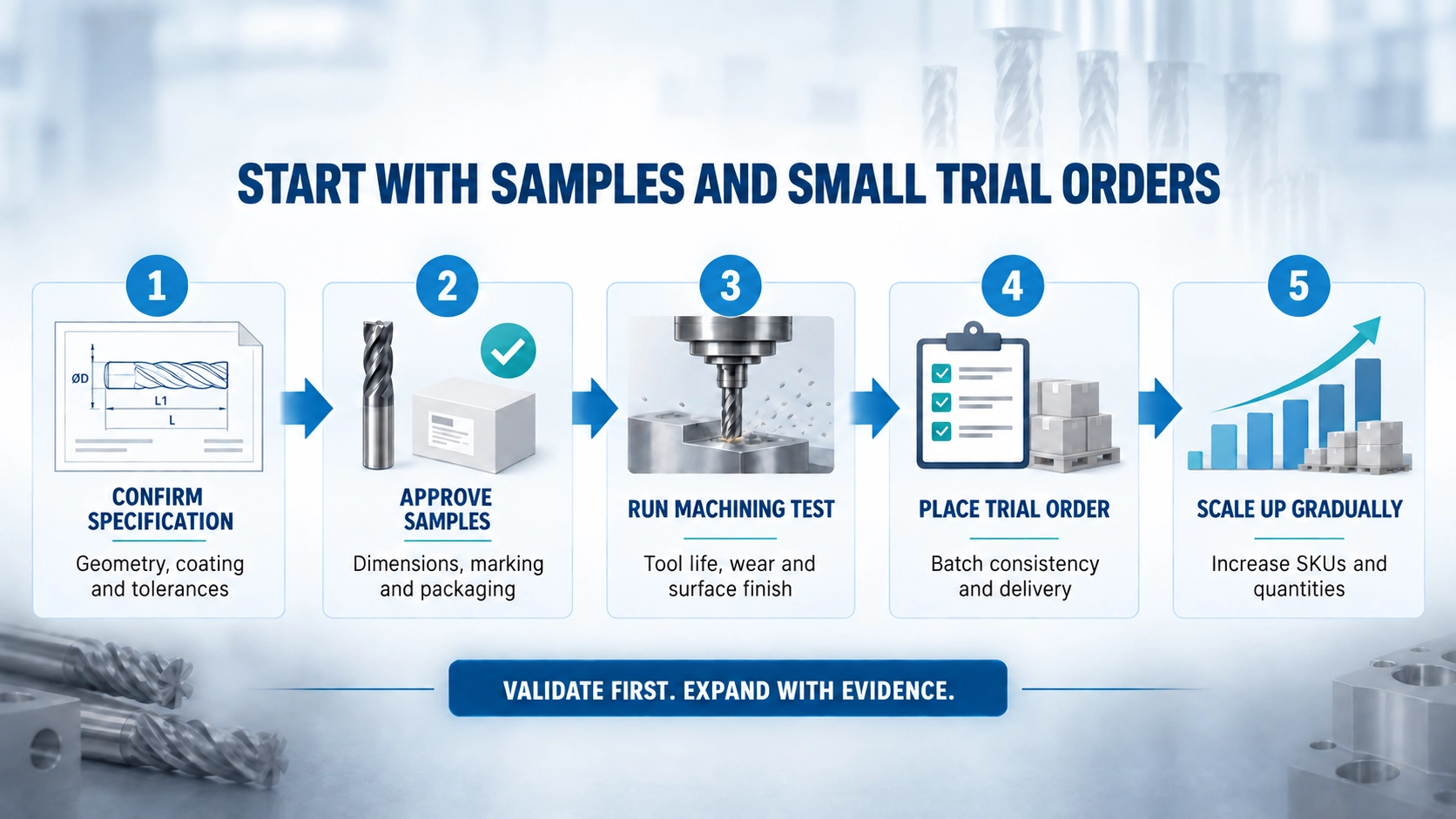
- Confirm the specification: freeze the tool size, geometry, coating and critical tolerances.
- Approve samples: check dimensions, appearance, marking and packaging before machining.
- Run a controlled machining test: compare tool life, wear, surface finish, dimensional stability and chip behavior.
- Place a small mixed-size order: verify order accuracy, batch consistency, packing and delivery.
- Increase quantities gradually: expand only after technical and commercial performance is confirmed.
For distributors, the first trial should usually include several high-turnover specifications instead of a large quantity of one uncertain model. This produces more useful market feedback and reduces the risk of slow-moving inventory.
7. Discuss Your OEM and Branding Needs
OEM service may include far more than putting a logo on a shank. Confirm the exact scope before approving the order.
| Customization Area | Details to Confirm | Approval Evidence |
|---|---|---|
| Tool marking | Logo, brand, model, size, batch code and marking position | Digital layout or marked sample |
| Label | Product code, barcode, application, origin and language | Print proof |
| Упаковка | Box or tube type, color, insert, label and outer carton | Packaging sample or approved artwork |
| Tool specification | Dimensions, geometry, substrate, coating and tolerances | Controlled drawing or specification sheet |
| Confidentiality | Drawing use, proprietary models and disclosure limits | Written confidentiality terms where required |
Swipe to view all columns.
For custom geometries, establish drawing ownership and permitted use. Define any exclusivity, territory, duration, volume conditions and development costs in writing.
HY Tools supports standard and custom tools made from drawings, samples or machining requirements. You can review the available custom tooling capabilities and the OEM marking and packaging FAQs before preparing an inquiry.
8. Check MOQ, Lead Time, Packaging and Supply Flexibility
Compare quotations using the same specification, quantity, packaging and commercial terms—not an unrealistic volume chosen only to lower the unit price.
Before selecting an OEM cutting tool manufacturer, confirm:
- MOQ for standard tools, custom tools, laser marking, labels and printed boxes;
- whether different sizes or tool types can be combined;
- sample, trial-order and production quantities;
- price levels at realistic order quantities;
- standard-production and custom-production lead times;
- whether coating time is included in the quoted schedule;
- packaging method and protection during international transport;
- shipping terms, export documents and delivery responsibilities.
Lead time should be tied to the actual specification. A standard uncoated tool, a coated standard tool and a newly developed form cutter should not be expected to follow the same schedule. Ask when the lead-time clock begins: after payment, after drawing approval, after sample confirmation or after packaging artwork approval.
9. Assess Communication, Problem Solving and Repeat-Order Support
Clear communication is part of manufacturing quality. If the supplier does not confirm a missing tolerance or unclear application before quoting, the same assumption may continue into production.
A reliable OEM partner should be able to:
- identify missing information before confirming the order;
- separate confirmed facts from recommendations;
- record drawing and specification revisions;
- explain changes in price or lead time;
- respond with useful questions instead of generic sales claims;
- investigate quality concerns using tool, batch and machining data;
- retain confirmed information for repeat orders.
When a performance problem occurs, both parties need evidence. The buyer should keep the affected tools and provide photos, quantities, batch information, workpiece material, hardness, RPM, feed, depth of cut, coolant and failure symptoms. The manufacturer should review the tool condition, measurements and production information before proposing replacement, remake, parameter adjustment or another solution.
OEM Cutting Tool Manufacturer Evaluation Scorecard
Use the following example scorecard when comparing shortlisted suppliers. Score each area from 1 to 5, then add comments and evidence instead of relying only on the total. Adjust the weighting according to product risk, order volume and application requirements.
| Evaluation Area | Suggested Weight | Evidence to Review |
|---|---|---|
| Relevant manufacturing capability | 20% | Product-specific equipment, process route and examples |
| Quality control and consistency | 20% | Inspection method, records, sample and batch controls |
| Technical and customization support | 15% | Drawing review, geometry options and application questions |
| Sample and trial-order support | 10% | Sample plan, mixed-size option and test response |
| MOQ and commercial fit | 10% | Realistic quantity tiers, branding and packaging costs |
| Lead time and supply reliability | 10% | Confirmed schedule, capacity explanation and repeat-order plan |
| Communication and documentation | 10% | Clear quotation, revision control and response quality |
| After-sales problem solving | 5% | Claim process, investigation method and corrective response |
Swipe to view all columns.
What to Prepare Before Requesting an OEM Cutting Tool Quote
A complete inquiry makes quotations faster and easier to compare. Prepare as much of the following information as possible:
| Information | Examples | Why the Manufacturer Needs It |
|---|---|---|
| Tool type | Square end mill, ball nose, step drill, reamer or thread mill | Defines the basic manufacturing route |
| Размеры | Diameter × cutting length × shank × overall length | Supports feasibility, material and price calculation |
| Заготовка | Steel, stainless steel, hardened steel, aluminum or composite | Guides substrate, geometry and coating selection |
| Операция | Slotting, side milling, finishing, drilling, reaming or threading | Clarifies cutting engagement and performance requirements |
| Quantity | Sample quantity and expected production quantity | Affects unit cost, process planning and lead time |
| Special requirements | Tolerance, runout, coating, coolant holes, logo or packaging | Prevents missing costs and later specification changes |
| Reference | Drawing, current model, photo or physical sample | Reduces ambiguity and supports cross-checking |
Swipe to view all columns.
Final Recommendation
The best OEM cutting tool manufacturer is not automatically the factory with the largest catalog or the lowest first quotation. It is the manufacturer that can understand your product plan, confirm the required specification, produce it consistently, inspect the critical features and support the same standard when you reorder.
Start with a clearly defined group of products, request evidence that relates to those tools and validate the supplier through samples and a controlled trial order. Once quality, communication and delivery have been confirmed, expand the number of SKUs and order quantities in stages.
Часто задаваемые вопросы
What should I look for in an OEM cutting tool manufacturer?
Review relevant production capability, specification control, inspection methods, batch consistency, customization scope, trial-order support, realistic lead time and the process used to handle repeat orders and quality concerns.
Is OEM the same as private label cutting tools?
Not always. Private label typically starts with an existing or lightly modified product sold under the buyer’s brand. OEM may include buyer-defined dimensions, geometry, materials, coatings and performance requirements. Because suppliers use these terms differently, confirm the exact scope in writing.
Should I request samples before placing an OEM order?
Yes, especially for a new supplier, coating, geometry or custom design. Confirm that the sample represents the intended production specification, then test it under recorded machining conditions before increasing the quantity.
What information is needed for an OEM cutting tool quotation?
Provide the tool type, dimensions, quantity, workpiece material and hardness, machining operation, required tolerances, coating, branding and packaging requirements. Add a drawing, current model, catalog page, photo or sample when available.
Can small quantities be used for an OEM trial order?
That depends on the tool and customization level. Standard tools and laser marking may support smaller quantities, while special geometry, coating, labels or printed packaging may have separate minimums. Confirm each MOQ separately rather than assuming one quantity applies to the whole project.