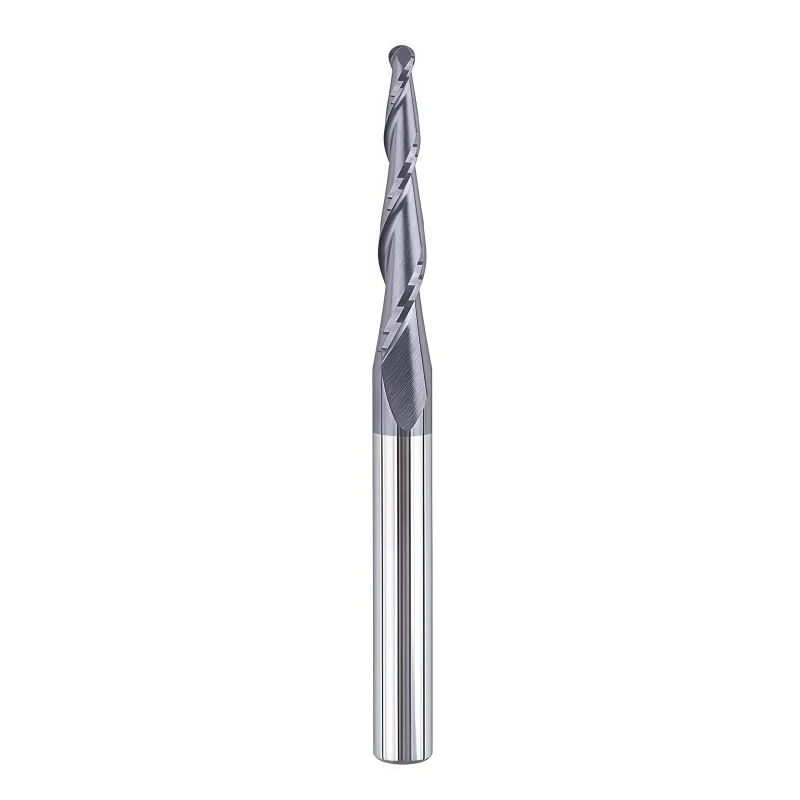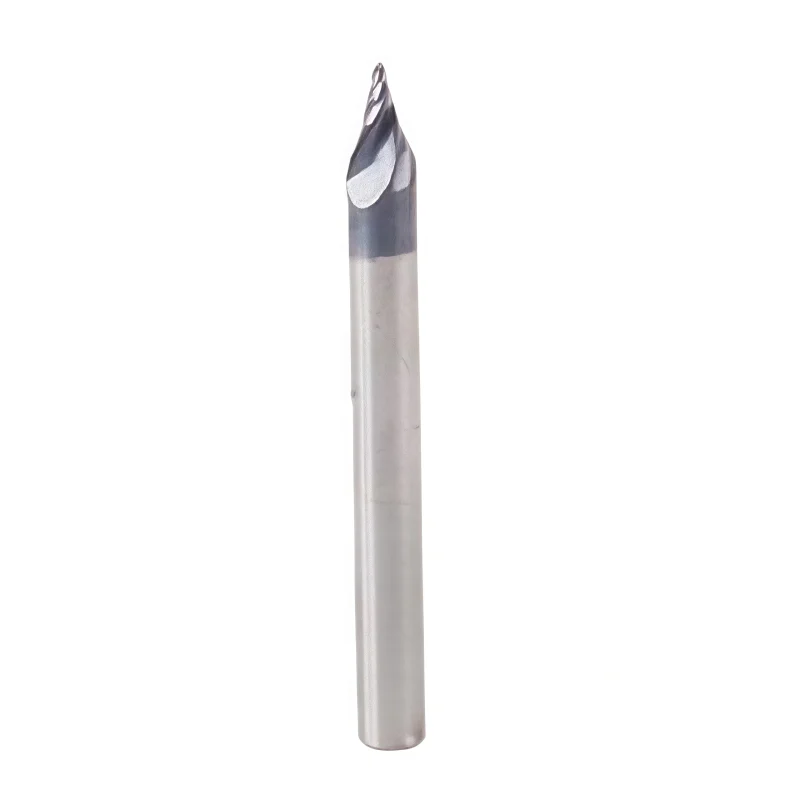

2-Flute DLC-Coated Solid Carbide Tapered Ball Nose End Mill for Wood & Acrylic
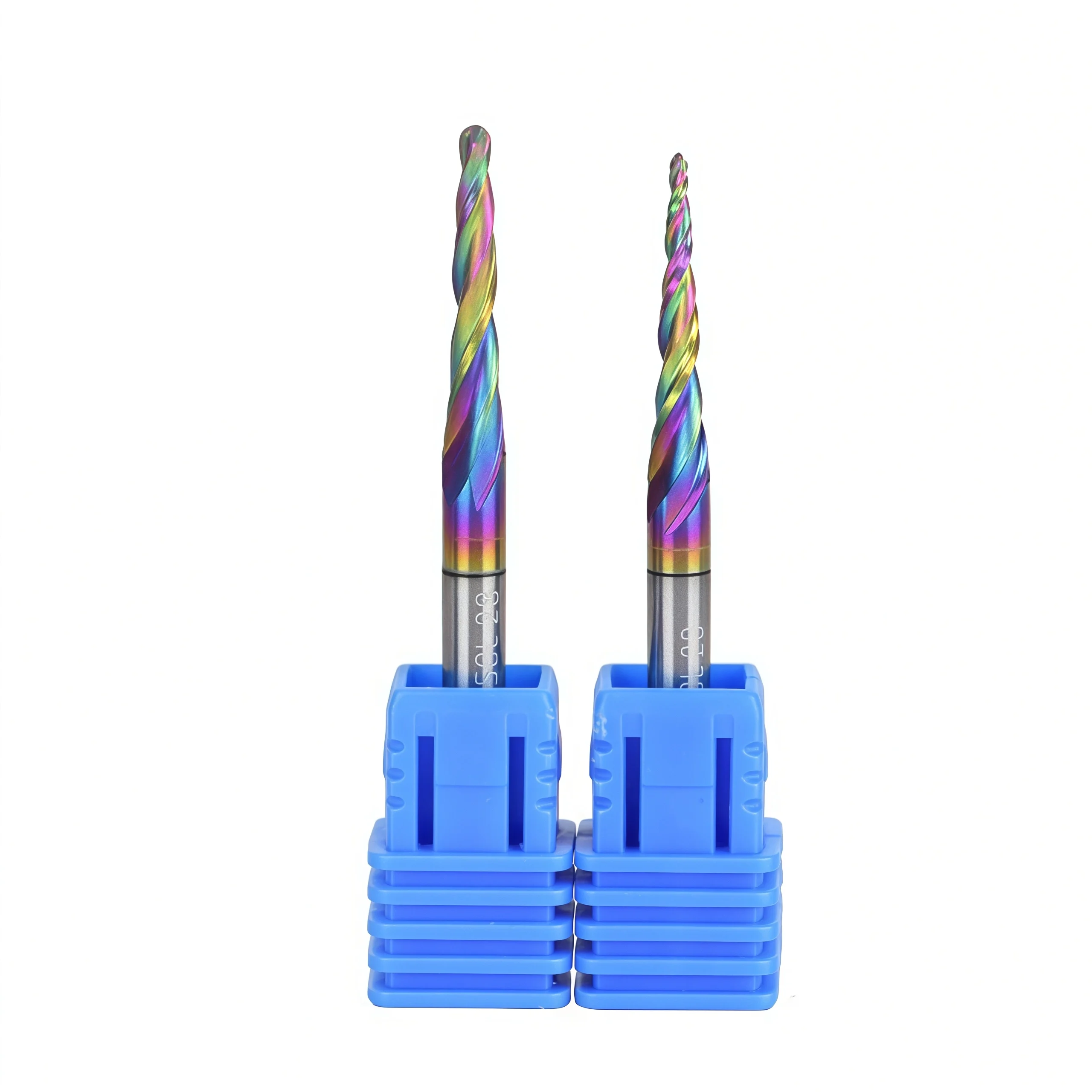
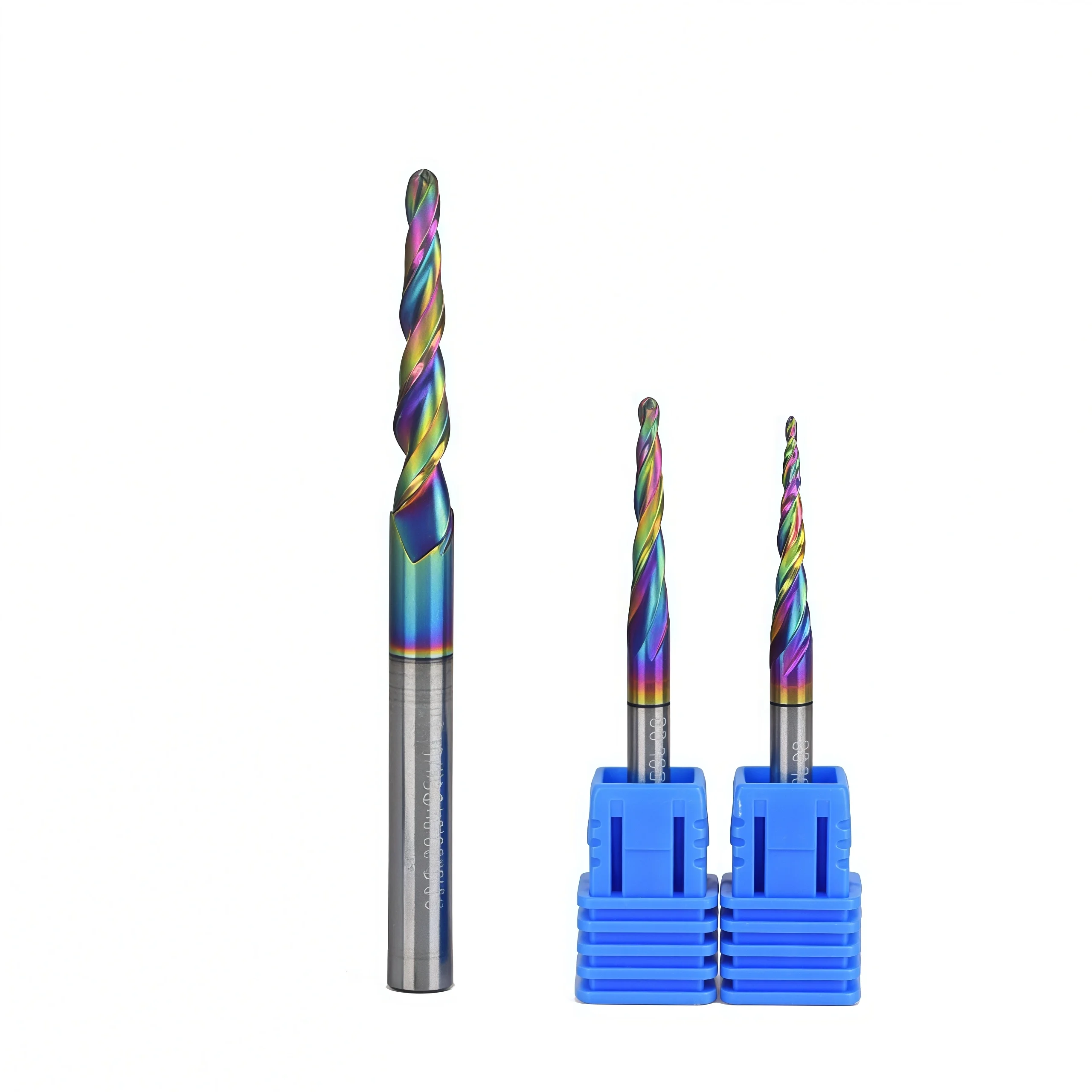
This 2-flute DLC-coated solid carbide tapered ball nose end mill is designed for precision engraving, 3D carving and contour machining of wood, acrylic and plastic materials.
- ◆Tapered ball nose geometry provides a fine cutting tip with improved rigidity
- ◆2-flute design supports smooth cutting and efficient chip evacuation
- ◆DLC coating helps reduce friction, resin buildup and acrylic adhesion
Custom tip radius, taper angle, cutting length, shank size, laser marking and packaging are available for OEM and ODM orders.
Consistent Quality
Consistent geometry across repeat orders.
Гибкие заказы
Small batches and mixed sizes available.
OEM Support
Custom marking, labels and packaging.
Стандартные и индивидуальные
Standard sizes and custom configurations.
DLC-Coated Solid Carbide Tapered End Mill Overview
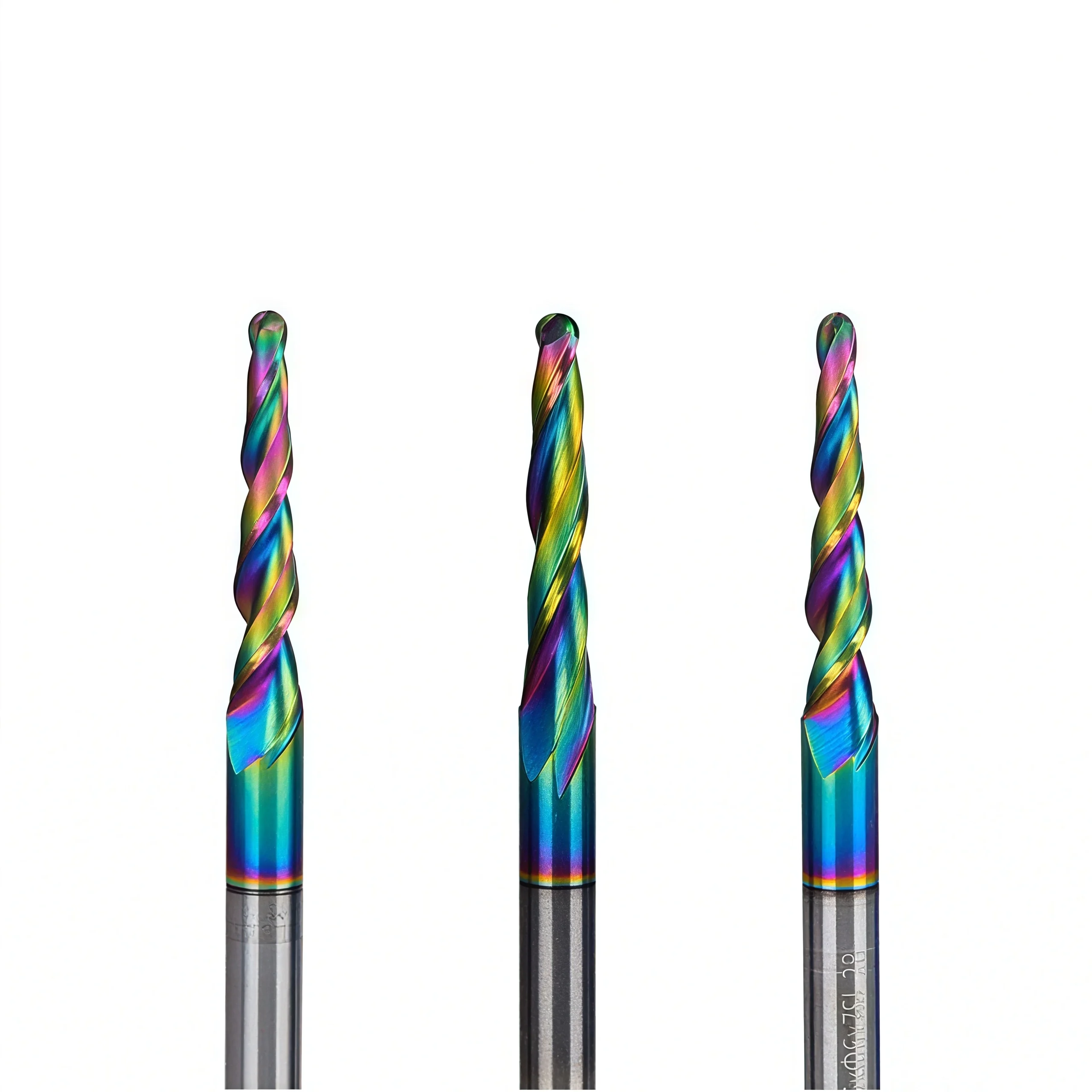
This 2-flute DLC-coated solid carbide tapered ball nose end mill is designed for precision 3D carving, relief engraving, curved-surface finishing and detailed CNC routing in wood, MDF, plywood, acrylic and selected plastic materials. The tapered body provides additional support behind the cutting end, while the ball nose follows curved and blended surfaces for detailed contour work. A 2-flute geometry provides practical chip space for routing and engraving, and the low-friction DLC coating helps reduce resin or plastic adhesion while supporting consistent cutting-edge performance. Reference sizes cover Ø3–Ø12 mm with 3°, 5° and 7° taper options.
Tapered Ball Nose
2 Flutes
DLC
Ø3–Ø12 mm
Tapered Ball Nose Configuration
Reinforced Tapered Body
The increasing body diameter provides additional support behind the cutting end for detailed carving, relief work and extended-reach contour machining.
Ball Nose Cutting Profile
The rounded cutting end follows curved, sloped and blended surfaces for 3D carving, relief engraving and smooth contour finishing.
Low-Friction DLC Surface
The DLC coating helps reduce friction and material adhesion when machining resin-containing wood products, acrylic and selected plastics.
Application-Specific Advantages
Tapered Feature Access
The tapered profile provides clearance for relief details, inclined walls and narrow three-dimensional features.
Smooth 3D Contouring
Ball-end geometry supports continuous toolpaths across curved, blended and sculptured surfaces.
Open Chip Space
Two flutes provide practical chip clearance for CNC routing, carving and detailed finishing operations.
Reduced Material Adhesion
The low-friction coating helps limit resin and plastic buildup on the cutting surface during continuous machining.
Recommended Routing & Engraving Operations
This tapered ball nose cutter is intended mainly for detailed 3D machining rather than high-volume straight-edge routing. Final cutting conditions should be matched to the tip radius, taper angle, cutting length, workpiece material and machine rigidity.
RECOMMENDED
RECOMMENDED
RECOMMENDED
SUITABLE
Use smooth toolpaths, controlled step-over and the shortest practical tool overhang. For acrylic, maintain effective chip evacuation to reduce heat accumulation and edge melting.
Workpiece Material Compatibility
| MATERIAL GROUP | APPLICATION | APPLICATION LEVEL |
|---|---|---|
| Wood | Solid wood carving, decorative profiles and three-dimensional finishing | Primary application |
| MDF & Plywood | Relief carving, lettering, decorative routing and detailed contour work | Primary application |
| Acrylic / PMMA | Detailed engraving, curved surfaces and light 3D machining with controlled chip evacuation | Recommended configuration |
| Selected Plastics | Detail routing and contour finishing according to plastic type and heat sensitivity | Application review |
For acrylic and thermoplastic materials, chip evacuation and heat control are especially important. The DLC coating reduces friction, but final cutting conditions should still be matched to the specific material and machine setup.
Tool Nomenclature & Dimensions
Reference dimensional nomenclature and standard configurations for the 2-flute DLC-coated solid carbide tapered ball nose end mill. Confirm the cutting diameter, ball radius, taper angle, flute length, shank diameter and overall length for the selected model. All listed dimensions are in millimeters.
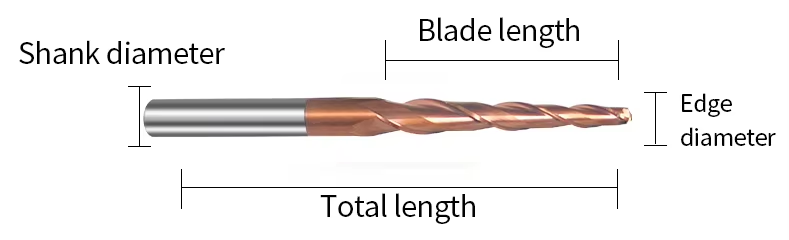
Technical Configuration
| PARAMETER | REFERENCE CONFIGURATION |
|---|---|
| Tool Material | Твердый карбид |
| Тип инструмента | Tapered Ball Nose End Mill |
| Флейта | 2 Flutes |
| Диапазон диаметров | Ø3–Ø12 mm reference series |
| Ball Radius | Standard or customized according to model |
| Taper Angle | 5° standard / 3° and 7° optional |
| Угол спирали | 30° standard / 35° optional |
| Покрытие | DLC — Diamond-Like Carbon |
| Primary Materials | Wood / MDF / Plywood / Acrylic / PMMA / Selected Plastics |
| Primary Operations | 3D Carving / Relief Engraving / Curved-Surface Finishing / Detail Routing |
| Тип машины | CNC Router / Engraving Machine |
Standard Size Matrix
Reference dimensional series for standard tapered ball nose configurations. Taper angle, ball radius and selected shank dimensions should be confirmed before production.
| CUTTING DIA. D | CUTTING LENGTH L1 | SHANK DIA. d | OVERALL LENGTH L |
|---|---|---|---|
| 3 | 10 | 6 | 50 |
| 4 | 12 | 6 | 60 |
| 6 | 15 | 8 | 75 |
| 8 | 18 | 10 | 85 |
| 10 | 20 | 12 | 100 |
| 12 | 25 | 16 | 120 |
Wood & Acrylic Application Guidance
- Tool Overhang: Use the shortest practical extension to improve rigidity and reduce vibration during detailed carving.
- Acrylic Heat Control: Maintain effective chip evacuation and avoid excessive rubbing to reduce melting or material adhesion.
- Wood & MDF: Use suitable dust extraction or air evacuation to prevent chips and fine particles from accumulating around the cutting zone.
- Step-Over: Select step-over according to the ball radius, surface curvature and required surface finish.
- Toolholding: Use a clean, low-runout collet or precision holder and verify clamping before high-speed routing.
2-Flute Tapered Ball Nose End Mill Customization
Cutting diameter, ball radius, taper angle, cutting length, shank diameter, overall length, helix geometry, cutting-edge preparation and coating can be configured for mold details, three-dimensional contours and curved-surface finishing. Reference configurations use a 2-flute design with Ø3–Ø12 mm cutting diameters, 3°, 5° or 7° taper options and 30° or 35° helix options. Non-standard geometry can be reviewed according to the component profile, workpiece material, effective reach, surface-finish requirement and machine rigidity.
| PARAMETER | MANUFACTURING CAPABILITIES |
|---|---|
| Cutting Diameter | Reference cutting diameters range from Ø3 to Ø12 mm. Selected intermediate and non-standard diameters can be reviewed according to the tool or component drawing. |
| Ball Radius | True-radius and drawing-defined ball-end configurations can be reviewed according to the required surface profile, corner transition and finishing toolpath. |
| Taper Angle | Reference taper options include 3°, 5° and 7°. The drawing should specify whether the angle is measured per side or as the total included angle. |
| Taper Direction & Profile | Taper direction, small-end diameter, large-end diameter and tapered profile can be manufactured according to the mold feature, component drawing or existing tool sample. |
| Flute Configuration | Standard 2-flute geometry provides practical chip space for detailed contouring, mold finishing and higher-reach machining. |
| Helix Geometry | Reference 30° and 35° helix options can be selected according to the workpiece material, chip formation, cutting load and required surface condition. |
| Cutting & Overall Length | Cutting length, effective reach and overall length can be configured according to the feature depth, holder clearance and required tool rigidity. |
| Shank Configuration | Precision cylindrical shank with standard or drawing-defined shank diameter and clamping length. |
| Ball Nose Geometry | Ball-end profile, center geometry and cutting-edge transition can be reviewed for curved surfaces, blended profiles, relief features and mold details. |
| Cutting-Edge Preparation | Rake geometry, relief, edge preparation and flute finishing can be selected according to the workpiece material, effective cutting radius and finishing requirement. |
| Coating Selection | TiSiN and AlTiN-TiSiN options can be reviewed for confirmed steel applications. Uncoated or low-adhesion configurations can be selected separately for aluminum and other non-ferrous materials. |
| Machining Application | Geometry can be reviewed for 3D contouring, mold-detail finishing, curved-surface machining, relief work, engraving and light semi-finishing. |
| Dimensional Requirements | Drawing-defined requirements can be reviewed for cutting diameter, ball radius, taper angle, cutting length, shank diameter, overall length, profile accuracy and tool runout. |
Услуги по производству под брендом OEM и под частной торговой маркой
OEM manufacturing and private-label supply options are available for industrial distributors, tooling brands and repeat-production customers. Laser identification, label content, protective packaging and coating presentation can be configured according to the approved product specification and order requirements.

Laser Etching
Custom logos, tool codes, cutting dimensions, coating identification and batch numbers can be marked according to the available shank area.
Custom Labels & Packaging
Individual protective tubes, product labels, specification details, colored packaging tubes and private-label packaging can be reviewed.
Commercial Terms
MOQ, sample evaluation, custom-size trials, repeat orders and scheduled supply programs are confirmed according to the selected configuration.
Technical Workflow
A structured review process is used to confirm standard, customized and private-label square end mill requirements before production.
Inquiry
Submit the material, hardness, milling operation, dimensions, tolerance and quantity.
Engineering
Review flute geometry, helix angle, edge preparation, coating, ap and ae.
Commercial
Confirm quotation, MOQ, sample requirements, production schedule and delivery terms.
Production
CNC grinding, end-face formation, edge preparation, coating and laser marking.
Quality Control
Inspect diameter, flute length, shank, runout, square-end geometry and cutting edges.
Quality, Inspection & Delivery
Our solid carbide square end mills are controlled through material verification, precision grinding, in-process measurement and final inspection. Key dimensions, square-end geometry, cutting-edge condition, coating appearance and product identification are reviewed according to the approved specification or drawing before packing.

Three-Stage Quality Control
Inspection checkpoints are arranged around the manufacturing process to support dimensional consistency and repeat-order control.
Incoming Material Control
Carbide substrate grade, blank dimensions and supplied material information are checked against the production requirement.
In-Process Grinding Control
Cutting diameter, flute geometry, flute length, square-end profile and shank dimensions are monitored during CNC grinding.
Final Tool Inspection
Finished tools are reviewed for specified dimensions, runout, cutting-edge condition, coating appearance, marking and packing identification.
Key Inspection Characteristics
Inspection requirements are confirmed according to the standard product specification or the approved custom drawing.
| INSPECTION ITEM | CONTROL FOCUS | CONFIRMATION BASIS |
|---|---|---|
| Cutting Diameter (DC) | Diameter and dimensional consistency | Standard specification or approved drawing |
| Flute Length (APMX) | Effective cutting length | Confirmed product size or drawing requirement |
| Shank Diameter (DCON) | Clamping-section dimension and surface condition | Applicable shank specification |
| Общая длина (OAL) | Total tool length | Standard size matrix or approved drawing |
| Радиальное биение | Concentricity between cutting section and shank | Agreed inspection requirement |
| Square-End Geometry | End-face profile, corner condition and center-cutting form | Selected tool configuration |
| Flute & Helix Profile | Flute count, helix form and grinding consistency | Approved manufacturing configuration |
| Cutting Edge & Coating | Edge condition, visible defects and coating appearance | Application-specific production requirement |
| Marking & Identification | Tool code, dimensions and batch information where applicable | Confirmed order and packaging specification |
Measurement & Batch Traceability
Optical measuring systems, tool inspection equipment and appropriate dimensional gauges are selected according to the feature being checked.
Optical Measurement
Profile and dimensional review of specified cutting features.
Runout Verification
Concentricity review based on the agreed product requirement.
Edge Inspection
Magnified review of the end face, corners and cutting-edge condition.
Batch Identification
Order, product and batch information are linked where required for repeat supply.
Protective Packaging Process
Finished end mills are protected to reduce contact between cutting edges and to support clear product identification during storage and transportation.

Bulk-Order & Export Packaging
Bulk shipments can be arranged with reinforced cartons, protective wrapping, palletized loading or export cases according to order quantity, shipment weight and agreed transportation requirements.

Delivery Coordination
Production completion, packing method and dispatch arrangements are confirmed according to the approved order. Courier, air, sea or customer-designated shipping options can be reviewed according to shipment size and destination. Final lead time is confirmed after product specifications, quantity and packaging requirements are approved.
Product & Application FAQs
Answers to common questions about selecting and applying the 2-Flute DLC-Coated Solid Carbide Tapered Ball Nose End Mill for wood, MDF, plywood, acrylic, PMMA and selected plastic materials.
What materials is this DLC-coated tapered ball nose end mill designed for?
What machining operations are suitable for this tapered ball nose profile?
What is the advantage of the DLC coating when machining wood and acrylic?
Why use a tapered body instead of a straight ball nose cutter?
How should the tool be used when machining acrylic or PMMA?
How should step-over be selected for 3D carving and surface finishing?
Ordering & Customization FAQs
Information for distributors, woodworking-tool suppliers, CNC routing customers and buyers requesting standard or application-specific DLC-coated tapered ball nose configurations.
What standard sizes are available?
Can non-standard dimensions or geometry be manufactured?
Are OEM marking and private-label packaging available?
Каковы обычные сроки выполнения заказа?
What information is required for an accurate quotation?
Technical Downloads
Use the following references for product selection and starting machining-data review.
Solid Carbide End Mill Catalog
Review related ball-nose, tapered, square-end, corner-radius and application-specific solid carbide cutter series.
End Mill Speeds & Feeds Guide
Access reference starting parameters for CNC routing, engraving and controlled machining trials.
Need a Size or Application Review?
Send the workpiece material, required cutting diameter, ball radius, taper angle, flute length, machining depth, surface-finish requirement and quantity for configuration and quotation review.
Need Sizes, Pricing or Custom Options?
Send us the required tool type, sizes, quantities, workpiece material and any OEM or custom requirements. We will confirm suitable specifications, availability, lead time and quotation details.
Drawings, size lists and reference photos are welcome.