How to Choose a 4 Flute Carbide End Mill for Steel and Stainless Steel
A 4 flute carbide end mill is one of the most common milling tools for steel, stainless steel, alloy steel, mold steel, and many general CNC machining applications.
Compared with 2 flute or 3 flute tools, a 4 flute design usually provides better core strength, more cutting edges, and stable performance in side milling, profiling, and finishing.
However, 4 flute does not mean it is suitable for every material or every operation.
If the flute count, coating, tool overhang, machine rigidity, or cutting strategy is not matched correctly, a 4 flute carbide end mill can still cause chatter, poor chip evacuation, edge chipping, or short tool life.
In this guide, we explain when to use a 4 flute carbide end mill, when it may not be the best choice, and how to choose the right tool for steel and stainless steel milling.
Table of Contents
- What is a 4 flute carbide end mill?
- Why 4 flute end mills are common for steel and stainless steel
- 4 flute vs 2 flute vs 3 flute: what changes?
- When should you use a 4 flute carbide end mill?
- When is 4 flute not the best choice?
- How to reduce chatter and chipping with a 4 flute end mill
- Coating and geometry selection
- Application selection table
- Common mistakes to avoid
- Final recommendation
What Is a 4 Flute Carbide End Mill?
A 4 flute carbide end mill is a solid carbide milling cutter with four cutting edges.
These four flutes remove material as the tool rotates, making it suitable for many common CNC milling operations.
Compared with high-speed steel tools, solid carbide end mills usually offer better hardness, wear resistance, and rigidity. This makes them widely used in steel, stainless steel, alloy steel, mold steel, and other metal machining applications.
The 4 flute structure gives the tool a stronger core than many lower-flute designs.
It also provides more cutting edges, which can help improve cutting stability and surface finish under suitable conditions.
Actual rigidity still depends on tool diameter, flute geometry, cutting length, carbide substrate, and overall tool design.
Because there are more flutes, the chip space is smaller than a 2 flute or 3 flute tool.
This means chip evacuation must still be considered, especially in slotting, deep pockets, or sticky materials.
Why 4 Flute End Mills Are Common for Steel and Stainless Steel
A 4 flute carbide end mill is commonly used for steel and stainless steel because these materials usually benefit from strength, rigidity, and stable cutting.
Better Core Strength
More flutes usually mean a stronger tool core.
This helps the end mill resist deflection during side milling, profiling, and finishing.
For steel and stainless steel, cutting forces are often higher than in aluminum.
A stronger core can help keep the tool more stable.
More Cutting Edges
A 4 flute tool has more cutting edges than a 2 flute or 3 flute tool.
Under suitable conditions, this can support a higher table feed while keeping the chip load per tooth controlled.
Good for Side Milling and Profiling
For side milling, profiling, and general steel milling, 4 flute carbide end mills are often a practical starting point.
They can provide a good balance of tool strength, cutting stability, and productivity.
Better Finishing Stability
Because more cutting edges are engaged, a 4 flute end mill can often produce a smoother finish than lower-flute tools, especially in stable machines and rigid setups.
Suitable for Coated Tools
Steel and stainless steel often require coated carbide end mills.
A 4 flute design works well with coatings such as TiAlN or AlTiN when heat resistance and wear resistance are important.
The final coating choice should still depend on material grade, coolant condition, cutting speed, and application type.
4 Flute vs 2 Flute vs 3 Flute: What Changes?
Flute count affects chip evacuation, core strength, feed capability, and cutting stability.
| Item | 2 Flute End Mill | 3 Flute End Mill | 4 Flute End Mill |
|---|---|---|---|
| Chip Evacuation | Excellent | Very good | Moderate |
| Core Strength | Lower | Balanced | Higher |
| Common Material Use | Aluminum, non-ferrous materials | Aluminum and general applications | Сталь, нержавеющая сталь, легированная сталь |
| Slotting Performance | Good chip space | Balanced | Requires better chip control |
| Side Milling Stability | Moderate | Good | Very good |
| Отделка поверхности | Moderate to good | Good | Good to very good |
| Best Use | Chip evacuation priority | Balance of chip flow and productivity | Stability, strength, finishing |
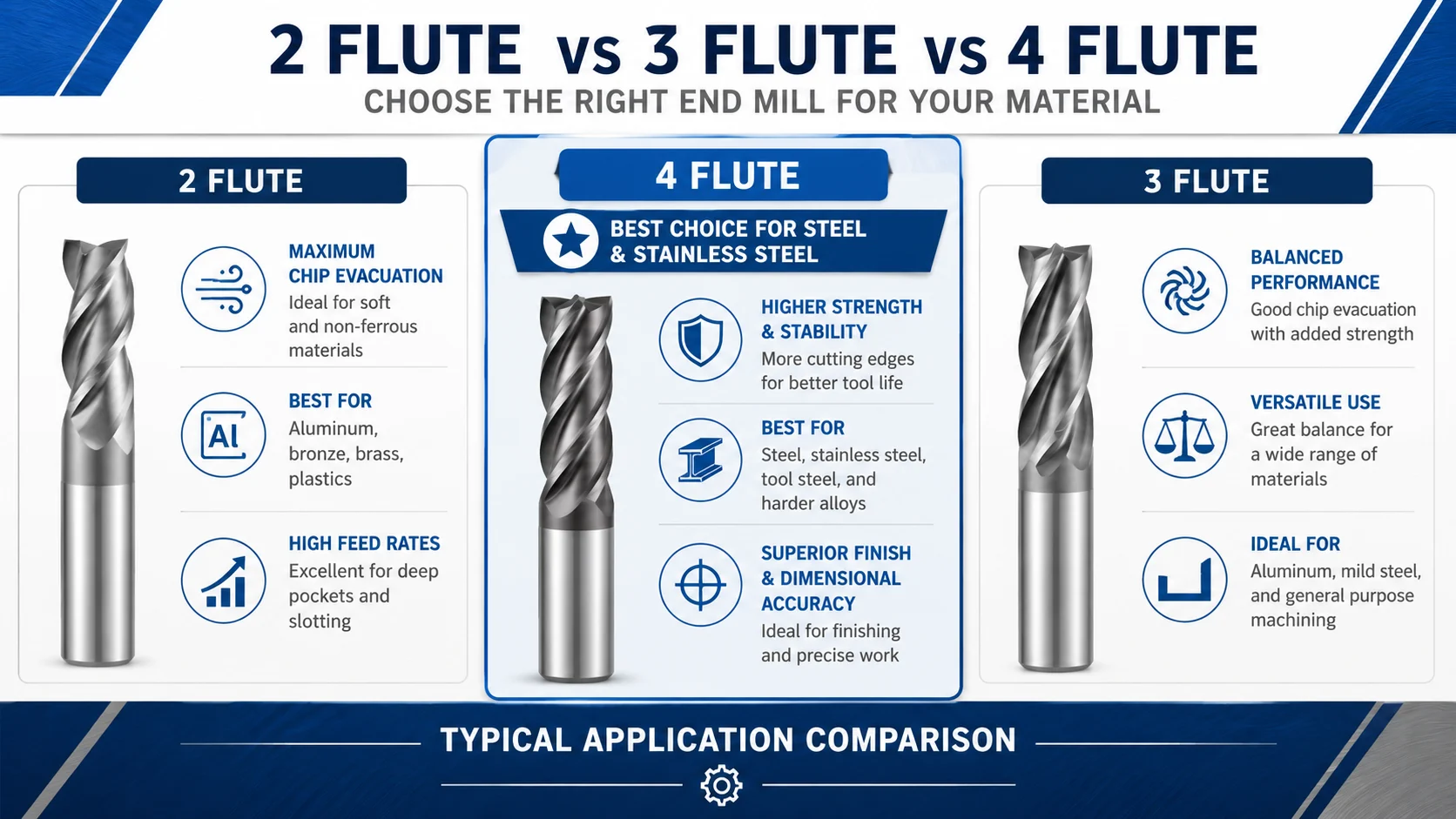
A 4 flute carbide end mill is commonly used for steel and stainless steel milling where rigidity, stable cutting, and surface finish are important.
This does not mean 4 flute is always better.
It means 4 flute is often better when the operation needs rigidity, stable side cutting, and good surface finish.
For aluminum, especially deep slotting or heavy chip evacuation, 2 flute or 3 flute tools are often more suitable.
For steel and stainless steel, 4 flute tools are more common because rigidity and edge support often become more important.
When Should You Use a 4 Flute Carbide End Mill?
A 4 flute carbide end mill is a good choice when the material, machine, and operation require stable cutting.
General Steel Milling
For carbon steel and alloy steel, a 4 flute carbide end mill is often a practical standard choice.
It offers a strong tool body and stable cutting performance in many common operations.
Stainless Steel Milling
For stainless steel, a 4 flute carbide end mill can be a practical starting point, but coating, edge preparation, rigidity, and cutting strategy are just as important as flute count.
Stainless steel can generate heat and work hardening, so tool selection should not be based on flute count alone.
You can also review our guide on choosing an end mill for stainless steel for more details.
Side Milling
A 4 flute tool works well in side milling when the setup is rigid and chip evacuation is controlled.
This is one of the most common applications for 4 flute carbide end mills.
Profiling
For profiling operations, a 4 flute tool can help maintain stability and surface quality.
If the workpiece geometry is thin or the setup is weak, radial engagement and tool overhang should be controlled carefully.
Отделка
A 4 flute carbide end mill is often suitable for finishing because it can provide stable cutting and better surface finish.
For finishing, tool condition and runout control are especially important.
Stable CNC Setups
If the machine, holder, and workpiece clamping are rigid, a 4 flute tool can perform well in many steel and stainless steel applications.
When Is 4 Flute Not the Best Choice?
A 4 flute carbide end mill is useful, but it is not the correct answer for every situation.
Deep Slotting with Poor Chip Evacuation
Because 4 flute tools have less chip space, deep slotting can become difficult if chips cannot leave the cutting zone cleanly.
Chip recutting may increase heat and damage the cutting edge.
Aluminum Heavy Cutting
For aluminum, especially deep slots or high chip-volume cutting, 4 flute is usually not the safest default choice.
Aluminum often needs more flute space and smoother chip evacuation, so a 2 flute or 3 flute aluminum-specific end mill is often more suitable.
However, aluminum-specific 4 flute end mills can still be used in selected high-speed finishing or light radial engagement applications when chip evacuation is well controlled.
Weak Machine or Poor Setup
If the machine lacks rigidity, the holder has poor clamping, or the tool overhang is too long, a 4 flute tool may still chatter. A stronger tool does not automatically fix a weak setup.
Sticky or Gummy Materials
In sticky materials, chip evacuation can become more important than core strength.
If chips pack into the flutes, tool performance can drop quickly.
Long Overhang Cutting
Long overhang increases deflection and vibration risk.
Even a 4 flute carbide end mill may chatter if the tool projection is too long.
How to Reduce Chatter and Chipping with a 4 Flute End Mill
A 4 flute carbide end mill can improve stability, but only when used correctly.
Keep Tool Overhang Short
Tool overhang is one of the first things to check.
The longer the tool sticks out from the holder, the easier it is to vibrate.
Use the shortest practical tool length for the operation.
For more detail, you can review our guide on how to reduce chatter in end milling.
Use a Rigid Holder
Holder rigidity and runout control are very important.
High runout can overload one cutting edge and lead to poor finish, chipping, or uneven tool wear.
Match the Tool to the Material
Use a tool designed for the material being machined.
A tool for aluminum is not the same as a tool for steel or stainless steel.
Control Radial Engagement
Too much radial engagement can increase cutting force and chatter.
Reducing radial depth of cut can help improve stability, especially in side milling and profiling.
Watch Tool Wear
A worn cutting edge increases cutting pressure.
Once the tool becomes dull, it may rub instead of cutting cleanly.
This can cause heat, chatter, chipping, and poor surface finish.
Improve Chip Evacuation
Even though steel and stainless steel usually produce less chip volume than aluminum, chip evacuation still matters.
If chips are recut, heat rises and tool life can drop quickly.
Coating and Geometry Selection
Choosing a 4 flute carbide end mill is not only about flute count.
Coating and geometry can strongly affect performance.
Покрытие
For steel and stainless steel, heat-resistant coatings are commonly used.
TiAlN and AlTiN coatings are often selected for steel, stainless steel, and higher-temperature cutting conditions.
For additional background on milling different materials, you can review this external guide on milling different workpiece materials.
Edge Preparation
A very sharp edge can cut easily, but it may also be fragile in tough materials.
A stable edge preparation helps balance sharpness and edge strength.
Угол спирали
Helix angle affects chip formation, cutting force, and surface finish.
A suitable helix design can help improve smooth cutting and reduce vibration.
Corner Radius Option
For applications where edge chipping is a concern, a corner radius end mill may help improve tool life compared with a sharp square corner.
The right choice depends on the part geometry and surface requirements.
Application Selection Table
The table below gives a practical overview of when a 4 flute carbide end mill is suitable and what to watch during machining.
| Приложение | Is 4 Flute Suitable? | Notes |
|---|---|---|
| Steel side milling | Да | Good stability and tool strength. |
| Stainless steel profiling | Да | Coating, rigidity, and cutting strategy are important. |
| General finishing | Да | Can support better surface finish in stable setups. |
| Deep slotting | Be careful | Chip evacuation must be controlled. |
| Aluminum heavy cutting | Usually not ideal | 2 flute or 3 flute aluminum-specific tools may be better. |
| Long overhang cutting | Be careful | Setup rigidity is critical. |
| Mold steel machining | Often suitable | Coating and edge strength matter. |
| Roughing with heavy chip load | Depends | Chip evacuation and machine rigidity must be checked. |
A 4 flute carbide end mill is commonly used for steel and stainless steel milling where rigidity, stable cutting, and surface finish are important.
Common Mistakes to Avoid
Using 4 Flute for Every Material
A 4 flute carbide end mill is common for steel and stainless steel, but it is not universal.
For aluminum or non-ferrous materials, a different flute design may be more suitable.
Ignoring Chip Evacuation
More flutes mean less chip space.
If chips cannot leave the cut, heat and recutting can damage the tool.
Using Too Much Tool Overhang
Long overhang can cause chatter, even with a strong carbide tool.
Choosing Coating Without Considering Material
Different materials need different coatings and edge designs.
Choosing only by color or appearance is not reliable.
Running a Worn Tool Too Long
A worn tool increases cutting force and heat.
This can cause edge chipping, chatter, and poor finish.
Using Weak Holders
A high-quality end mill still needs a stable holder.
Poor clamping and high runout can reduce tool life quickly.
Final Recommendation
You can also review our general purpose and stainless steel end mill options to match the cutter design with your material and machining requirements.
A 4 flute carbide end mill is often a practical choice for steel, stainless steel, alloy steel, and many general CNC milling applications.
It is especially suitable for side milling, profiling, and finishing when the setup is stable and chip evacuation is controlled.
However, it is not a universal tool for every material or operation.
For aluminum, deep slotting, gummy materials, or weak setups, flute space, rigidity, and chip evacuation must be checked carefully.
To choose the right 4 flute carbide end mill, check these points:
- material type and hardness
- operation type
- tool diameter
- coating requirement
- tool overhang
- holder rigidity
- chip evacuation condition
- surface finish requirement
The best results come from matching the end mill, holder, machine, and cutting strategy together.