How to Choose a DLC-Coated End Mill Supplier: 7 Checks for Buyers
When you’re sourcing a DLC-coated end mill line for aluminum, what do you care about most?
Price? Lead time? Batch consistency? Or whether the supplier can actually support your customers’ high-silicon aluminum jobs?
For distributors and OEM buyers sourcing DLC-coated carbide end mills for aluminum, price is only one part of the decision. Tool geometry, coating consistency, batch traceability, trial-order flexibility, and technical support can matter just as much. This guide covers what to check before you choose an aluminum end mill supplier.
How to Choose a DLC End Mill Supplier
Price matters when you’re choosing a DLC end mill supplier. But it’s not the only thing. Here’s what really affects your risk and your customers’ satisfaction.
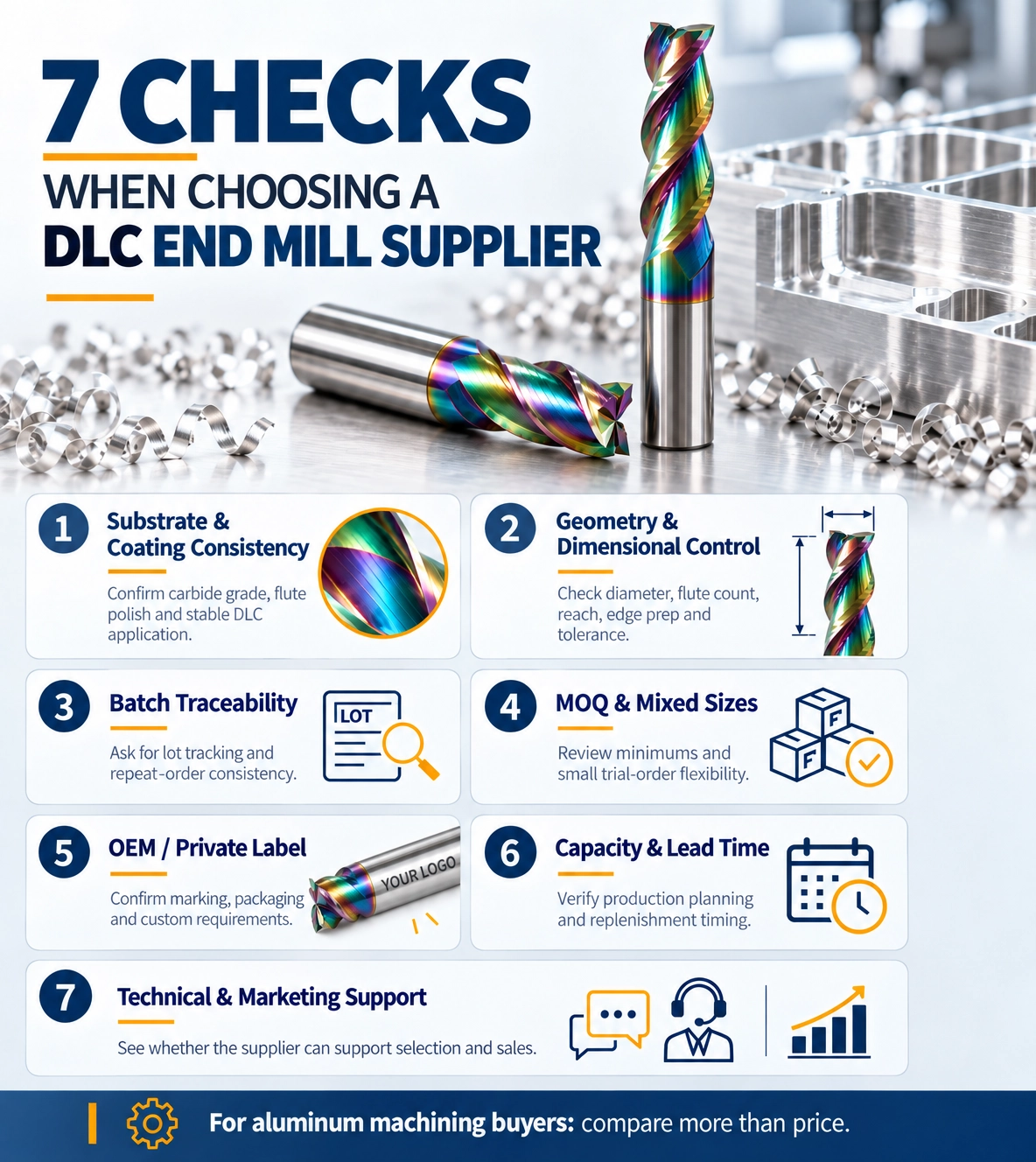
The supplier review process can be summarized into seven practical checks, as shown below.
1. Carbide substrate and coating consistency
Ask which carbide grade is used, which DLC coating system is applied, who applies the coating, and how coating consistency is verified from batch to batch. Outsourced coating is not necessarily a disadvantage, but the supplier should have a defined specification and inspection process.
2. Geometry and dimensional control
Ask how they control diameter tolerance, runout, and edge preparation. Can they provide dimensional inspection records?
3. Batch traceability
Batch-to-batch variation is one of the most common causes of distributor complaints, especially when repeat orders are expected to match previously approved samples. Ask if each batch is traceable.
4. MOQ and mixed-size orders
Confirm whether the supplier supports low-volume trials, mixed-size orders, and small custom runs before sampling. Can you mix different sizes in one order to meet the MOQ?
5. OEM and private label capability
Can they customize diameter, flute length, corner radius, coating, laser marking, and packaging? Can they produce under your brand?
6. Production capacity and lead time
Ask how capacity is managed during peak periods and whether any production steps are subcontracted. If subcontracting is used, confirm how the supplier maintains the same material, geometry, coating, and inspection standards.
7. Technical and marketing support
Recommended cutting parameters, application guides, and responsive technical contact help you support your customers. Catalogs, product photos, and data sheets reduce your selling effort.
Use these seven points as your supplier evaluation checklist before requesting samples or placing a trial order.
Why Use DLC-Coated End Mills for Aluminum?
DLC coatings are widely used for aluminum and other non-ferrous machining applications because their low-friction surface helps reduce material adhesion to the cutting edge. That solves the problems your customers complain about most: built-up edge, chip wrapping, poor surface finish, and tools wearing out too fast in high-silicon aluminum.
DLC isn’t for every job. But for aluminum and other non-ferrous materials where low friction, resistance to edge welding, and stable surface finish matter, it’s a strong product to have in your lineup.
When Does DLC Make More Sense Than an Uncoated Tool?
The question for buyers is not whether DLC works on aluminum, but whether the additional coating cost is justified for the target application. DLC becomes more attractive when adhesion, built-up edge, surface-finish requirements, or silicon-related wear limit the performance of a polished uncoated carbide tool.
DLC-coated end mills can be used on wrought aluminum such as 6061 and 7075 as well as cast and higher-silicon aluminum grades. The potential benefit becomes particularly noticeable when adhesion, built-up edge, or abrasive silicon content limits the performance of an uncoated tool.
Here’s a practical comparison for buyers:
| Option | Best suited for | Adhesion resistance | Abrasive Al-Si capability | Cost level |
|---|---|---|---|---|
| Polished uncoated carbide | General aluminum machining | Moderate–Good | Moderate | Lower |
| DLC-coated carbide | Aluminum / non-ferrous, anti-welding applications | High | Moderate–High | Higher |
| Diamond-coated / PCD | Highly abrasive high-silicon aluminum | Very high | Very high | Highest |
Source: coating supplier technical data and industry application guides. Actual performance depends on alloy, machine, and cutting conditions.
→ Download DLC Coating Data Sheet
When DLC Is NOT the Best Choice
DLC is not the best choice for every aluminum application. An uncoated or alternative tool may be more appropriate in the following cases:
- General roughing on 6061 where a polished uncoated carbide tool already performs well
- Steel or stainless steel applications, where other coating systems are generally more suitable for the heat and wear conditions involved
- Extremely abrasive applications where diamond-coated or PCD tooling offers a better economic case
Tool selection should therefore start with the alloy, machining operation, removal rate, surface-finish requirement, and expected tool life rather than coating alone.
Key Specifications Buyers Should Check
You need to know the core specs to judge whether a supplier’s tool fits your market. Here’s what actually matters for distributors and OEM buyers:
Substrate & coating
- Carbide grade / micro-grain substrate
- DLC coating type and source
- Coating thickness
Geometry
- Diameter range (metric and inch)
- Number of flutes
- Helix angle
- Flute polishing
- Cutting-edge sharpness
- Corner style (square, radius, ball)
- Center cutting capability
Tolerances
- Shank tolerance
- Diameter tolerance
Common configurations: 2- or 3-flute designs are widely used for aluminum, with polished flutes and relatively high helix angles commonly selected to improve chip evacuation and surface finish.
Typical Applications: 6061, 7075, ADC12 and High-Silicon Aluminum
DLC-coated end mills are used across a range of aluminum alloys. Here’s how buyers typically match the tool to the material:
| Material | Typical challenge | DLC benefit |
|---|---|---|
| 6061 | General machining, good finish required | Reduced adhesion, stable surface finish |
| 7075 | Higher strength, finishing operations | Less BUE, better surface quality |
| ADC12 | Cast aluminum, moderate silicon | Reduced sticking, improved chip evacuation |
| A390 / high-silicon | Abrasive silicon, fast tool wear | Improved wear resistance compared with polished uncoated carbide in suitable applications |
For extremely abrasive grades, diamond-coated or PCD tooling may offer a better economic case.
Cutting Parameter Reference by Aluminum Grade
The following ranges are general starting references for standard 2- or 3-flute carbide end mills. Final values should be selected according to tool diameter and radial engagement.

OEM and Custom Options
For many buyers, OEM is the deciding factor. Confirm whether the supplier supports standard sizes only, or also custom geometry, laser marking, private-label packaging, and distributor-specific product identification.
Ask about OEM MOQ, artwork requirements, and sample lead time. The clearer these terms, the smoother the partnership.
Commercial Terms Buyers Should Clarify
| Item | Confirm before ordering |
|---|---|
| MOQ | Per size or total order? |
| Mixed sizes | Allowed or not? |
| Sample policy | Free / paid / freight |
| OEM MOQ | Depends on marking, packaging, and tool configuration |
| Lead time | Standard vs custom |
| Payment | First order vs repeat order |
| Quote validity | Especially when carbide prices fluctuate |
Quality Documentation and Batch Traceability
Buyers need to answer customer complaints fast. A supplier with batch traceability makes that easier.
A supplier should be able to explain how non-conforming products are handled, including replacement, rework, credit, or corrective action procedures. Ask for:
- Raw material / substrate documentation where required
- Dimensional inspection records
- Batch identification
- Final inspection report upon request
HY Tools can provide inspection records and traceability information according to order requirements.
What Information Should You Send to a DLC End Mill Supplier?
Many buyers want to request a quote but aren’t sure what to include. Here’s what helps a supplier respond quickly and accurately:
- Aluminum alloy (e.g., 6061, 7075, ADC12, A390)
- Tool diameter
- Flute length / overall length
- Flute count
- Roughing or finishing
- Machine type and spindle speed
- Coolant method (wet, MQL, air)
- Quantity and OEM requirements
This information helps us prepare a more accurate tool recommendation and quotation with less back-and-forth.
How to Test a Supplier Before a Bulk Order
If you’re evaluating a DLC-coated aluminum end mill supplier, start with a sample and a small trial order. Test the tool on 6061, 7075, ADC12, or A390. Check surface finish, chip evacuation, and tool life.
A good sourcing process:
- Confirm the specification
- Review quality documentation
- Test several representative sizes
- Run a controlled comparison against your current tool
- Only then expand the order
Keep the workpiece material, holder, tool overhang, coolant strategy, spindle speed, feed, and evaluation criteria consistent wherever possible.
DLC Aluminum End Mill Buying FAQ
Q1: When should I choose DLC instead of an uncoated aluminum end mill?
A: Choose DLC when built-up edge, surface finish, or tool life is a recurring problem — especially with cast aluminum, high-silicon grades, or finishing operations. For general roughing on 6061, a polished uncoated tool may be enough.
Q2: Is DLC suitable for 6061 and 7075 aluminum?
A: Yes. DLC is used on wrought aluminum such as 6061 and 7075, as well as cast and high-silicon grades.
Q3: Is DLC suitable for high-silicon aluminum such as ADC12 or A390?
A: Yes. DLC helps reduce adhesion and improve wear resistance in higher-silicon aluminum. For extremely abrasive grades, diamond-coated or PCD tooling may offer a better economic case.
Q4: Should I choose 2-flute or 3-flute DLC end mills?
A: 2-flute designs provide more flute space for chip evacuation and can be useful in slotting, deep pockets, or applications with heavy chip loads. 3-flute designs provide a stronger core and more cutting edges while still maintaining good chip evacuation, making them a common choice for general aluminum milling and finishing.
Q5: Can different sizes be mixed in one trial order?
A: Yes. Mixed sizes are accepted. Please confirm the specific specs and quantities with our team.
Q6: Can you customize dimensions, corner radius and flute length?
A: Yes. We support custom geometry, dimensions, corner radius, and flute length. Send your drawing or specification.
Q7: Do you support private-label marking and packaging?
A: Yes. We offer custom laser marking and private-label packaging with your logo.
Q8: What information should I provide for a quotation?
A: Send your specification list — diameter, flute count, helix angle, coating, corner style, quantity, and any OEM requirements. We’ll prepare the appropriate tool configuration and quotation.