Ball Nose End Mill: When to Use It for 3D Profiling and Mold Machining
A Schaftfräser mit Kugelkopf is widely used for 3D profiling, mold machining, curved surface finishing, and complex contour milling. Unlike a square end mill, which has a flat cutting end, a ball nose end mill has a rounded tip.
This rounded cutting end allows the tool to follow curved surfaces more smoothly, making it especially useful for mold cavities, die surfaces, 3D contours, and finishing operations where surface quality matters.
However, a ball nose end mill is not the best tool for every milling operation. It is usually not ideal for sharp internal corners, high-efficiency flat-bottom slotting, or large flat surface machining where a square end mill may be more efficient.
In this guide, we explain when to use a ball nose end mill, how it differs from square and corner radius end mills, and how to choose the right tool for 3D profiling and mold machining.
Inhaltsübersicht
- What is a ball nose end mill?
- Ball nose end mill vs square end mill vs corner radius end mill
- Why ball nose end mills are used for 3D profiling
- 6 essential uses of a ball nose end mill
- When is a ball nose end mill not the best choice?
- How step-over affects surface finish
- How to choose the right ball nose end mill
- Application selection table
- Common mistakes to avoid
- Final recommendation
What Is a Ball Nose End Mill?
A Schaftfräser mit Kugelkopf, also called a ball end mill, is a carbide end mill with a rounded cutting end.
The radius at the tool tip allows the cutter to machine curved surfaces, 3D profiles, and contoured shapes more smoothly than a flat-end tool.
Ball nose end mills are commonly used in mold and die machining, 3D surface finishing, curved profiles, and semi-finishing operations.
They are especially useful when the toolpath needs to follow a complex surface instead of cutting a flat bottom or sharp corner.
Compared with square end mills and corner radius end mills, ball nose tools have a different purpose.
They are not mainly designed for sharp corners or high-efficiency flat-bottom machining. Their main strength is curved surface machining.
Ball Nose End Mill vs Square End Mill vs Corner Radius End Mill
Square end mills, corner radius end mills, and ball nose end mills are all useful, but they are designed for different machining needs.
Choosing the right one depends on part geometry, surface shape, tool life requirements, and finishing expectations.
| Werkzeug-Typ | Am besten für | Main Advantage | Limitation |
|---|---|---|---|
| Vierkant-Schaftfräser | Flat surfaces, slots, sharp internal corners | Can produce sharp 90-degree corners | Sharp corner may chip more easily in tough materials |
| Eckenradius-Schaftfräser | Steel, mold steel, profiling, finishing | Stronger corner and often better tool life | Cannot produce a perfectly sharp internal corner |
| Schaftfräser mit Kugelkopf | 3D surfaces, mold cavities, curved profiles | Smooth curved surface machining | Not ideal for sharp corners or efficient flat-bottom milling |
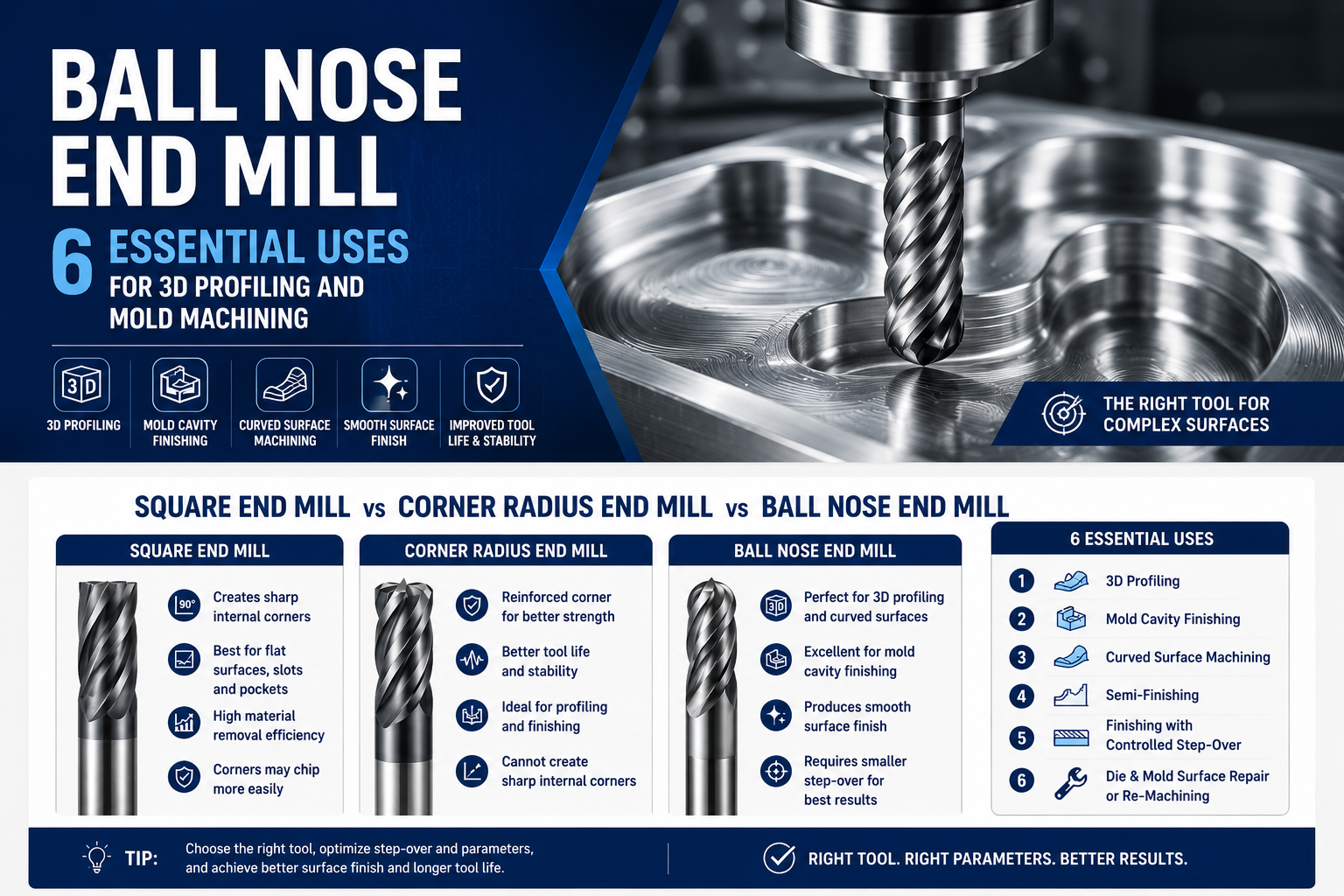
If the part requires a sharp internal corner, a square end mill is usually the better choice.
If the goal is stronger corner durability, a corner radius end mill may be more suitable.
If the part has curved surfaces, 3D profiles, mold cavities, or freeform features,
a ball nose end mill is often the better starting point.
Why Ball Nose End Mills Are Used for 3D Profiling
Ball nose end mills are used for 3D profiling because the rounded cutting end can follow curved geometry more naturally.
Instead of leaving a flat-bottom tool mark, the ball end creates a smoother transition along curved surfaces.
This makes ball nose tools useful for mold cavities, die surfaces, contoured parts, and complex 3D shapes.
In these applications, the final surface is often created by many toolpath passes with controlled step-over.
In 3D surface machining, surface quality is strongly affected by toolpath strategy, step-over, tool condition, and cutting parameters.
Research on ball-end milling of complex freeform surfaces also discusses toolpath planning and scallop height control as important factors in surface quality.
For additional technical background, you can review this research on ball-end milling tool trajectory planning for complex freeform surfaces.
Corner Radius End Mill vs Square End Mill.
6 Essential Uses of a Ball Nose End Mill
A ball nose end mill is most valuable when the tool needs to follow curved or 3D-shaped surfaces.
Below are six common applications where this tool type is often used.
1. 3D Profiling
3D profiling is one of the most common uses of a ball nose end mill.
The rounded tool tip helps the cutter follow complex contours and curved toolpaths more smoothly.
This is useful for parts with curved surfaces, organic shapes, or complex profiles that cannot be finished efficiently with a square end mill.
2. Mold Cavity Finishing
Mold cavities often contain curved surfaces, transitions, and detailed contour features.
A ball nose end mill can help finish these shapes with a smoother surface when step-over and toolpath are controlled properly.
This is why ball nose tools are widely used in mold and die machining, especially during semi-finishing and finishing.
3. Curved Surface Machining
When the part surface is not flat, a ball nose end mill can follow the curve more effectively than a flat-end cutter.
This makes it useful for machining curved surfaces in mold parts, die components, and complex 3D parts.
4. Semi-Finishing Before Final Finishing
After roughing, a ball nose tool can be used for semi-finishing to bring the part closer to the final surface shape.
This helps leave a more consistent stock allowance for the final finishing pass.
5. Finishing with Controlled Step-Over
In finishing operations, step-over control is very important.
A smaller step-over can reduce visible scallop marks and improve surface quality, but it also increases machining time.
Choosing the right step-over is therefore a balance between surface finish and production efficiency.
6. Die and Mold Surface Repair or Re-Machining
Ball nose end mills can also be useful for local re-machining, repair work, or finishing transition areas on mold and die surfaces.
When only a specific curved area needs to be improved, a ball nose tool can help blend the surface more smoothly.
When Is a Ball Nose End Mill Not the Best Choice?
A ball nose end mill is useful for curved surfaces, but it is not universal.
In some applications, another tool type may be better.
Sharp Internal Corners
A ball nose end mill cannot create a sharp internal corner.
If the part drawing requires a sharp 90-degree corner, a square end mill is usually required.
Flat-Bottom Slotting
For flat-bottom slots or pockets, a square end mill is usually more efficient.
A ball nose tool leaves a rounded bottom shape, which may not meet the part requirement.
Large Flat Surface Machining
If the goal is to machine a large flat surface efficiently, a ball nose end mill is usually not the best option.
Other tools may provide better efficiency and flatter results.
High-Efficiency Roughing
Ball nose tools can be used in some roughing strategies, but they are more commonly used for semi-finishing and finishing.
For heavy material removal, another roughing tool may be more suitable.
Poor Step-Over Control
If step-over is too large, the finished surface may show visible scallop marks.
Ball nose finishing requires controlled toolpath spacing for good surface quality.
How Step-Over Affects Surface Finish
Step-over is one of the most important factors in ball nose end milling.
It refers to the distance between adjacent toolpath passes.
A larger step-over can reduce machining time, but it usually leaves more visible scallop marks.
A smaller step-over can improve surface finish, but it increases cycle time.
Surface finish is also affected by tool wear, material hardness, surface inclination, cutting speed, feed rate, and machine rigidity.
Research on precise ball end milling has also shown that tool wear and ploughing behavior can influence surface finish during machining.
For additional background, you can review this study on ploughing phenomena and tool wear effects during ball end milling.
In practical machining, this means the best surface finish does not come from the ball nose tool alone.
It comes from the tool, toolpath, machine, holder, material, and cutting parameters working together.
How to Choose the Right Ball Nose End Mill
Choosing the right ball nose end mill depends on the material, surface shape, machining stage, and finish requirement.
Tool Diameter
Larger tools can be more rigid and may finish larger surfaces more efficiently.
Smaller tools are useful for detailed features, small radii, and tighter areas.
Radius der Kugel
The ball radius should match the part geometry and surface requirement.
A larger ball radius may improve rigidity and reduce machining time, while a smaller radius may be needed for fine details.
Flöte zählen
Flute count affects chip evacuation, feed capability, and cutting stability.
The right choice depends on material, operation type, and chip control requirements.
Beschichtung
For steel, stainless steel, and mold steel, coating can help improve wear resistance and heat resistance.
The final coating choice should depend on material grade, cutting speed, coolant condition, and machining strategy.
Cutting Length and Tool Overhang
Longer tools can reach deeper surfaces, but they are also more likely to deflect or chatter.
Use the shortest practical tool overhang whenever possible.
Machining Stage
A ball nose tool used for roughing may not be the best tool for finishing.
Semi-finishing and finishing often require better tool condition, smaller step-over, and more stable parameters.
Application Selection Table
The table below gives a practical overview of when a ball nose end mill is usually suitable.
| Anmeldung | Use Ball Nose? | Anmerkungen |
|---|---|---|
| 3D profiling | Yes | Main application for curved and contoured surfaces. |
| Mold cavity finishing | Yes | Good for curved cavity surfaces and smooth transitions. |
| Curved surface finishing | Yes | Step-over control is important for surface quality. |
| Flat-bottom slotting | Usually no | Square end mill is usually better. |
| Sharp internal corner | No | Ball nose tools cannot create sharp internal corners. |
| Aufrauen | Depends | Usually needs a suitable roughing strategy and stable setup. |
| Long-reach finishing | Be careful | Tool overhang, rigidity, and chatter risk must be controlled. |
| Surface repair or re-machining | Often yes | Useful for local curved surface blending and finishing. |
Common Mistakes to Avoid
Using Ball Nose Tools for Sharp Corners
A ball nose end mill cannot produce a sharp internal corner.
Always check the drawing requirement before choosing the tool.
Using Too Large Step-Over for Finishing
A large step-over may save time, but it can leave visible scallop marks on the surface.
For finishing, step-over should be selected according to surface quality requirements.
Ignoring Tool Wear
A worn ball nose edge can increase rubbing, ploughing, heat, and poor surface finish.
Tool condition should be checked regularly, especially in finishing applications.
Using Too Much Tool Overhang
Long overhang increases the risk of deflection and chatter.
Even the correct ball nose end mill may perform poorly if the setup is weak.
Choosing Diameter Only by Habit
Tool diameter should be selected based on surface shape, detail size, required finish, and machining efficiency.
Using the Same Tool for Roughing and Finishing
Roughing and finishing often have different requirements.
A tool used for roughing may not provide the best surface finish in the final pass.
Final Recommendation
A Schaftfräser mit Kugelkopf is a practical choice when the part has curved surfaces,
3D profiles, mold cavities, or complex contour features.
It is especially useful for 3D profiling, mold cavity finishing, curved surface machining,
semi-finishing, and finishing with controlled step-over.
However, it is not the best choice for every operation.
If the part requires a sharp internal corner, flat-bottom slotting, or high-efficiency flat surface machining,
a square end mill or another tool type may be better.
Before choosing a ball nose end mill, check these points:
- part surface shape
- material type and hardness
- tool diameter
- ball radius
- machining stage
- step-over requirement
- tool overhang
- surface finish requirement
The best results come from matching the ball nose end mill, toolpath, material, machine rigidity,
and cutting strategy together.