
How to Manage Carbide Cutting Tool Costs and Supply Risk During Tungsten Price Volatility
Your next replenishment list includes carbide end mills that sell every week, along with sizes that may sit on the shelf for months. With tungsten prices moving, should you buy ahead or wait?
The answer will be different for each item on that list.
Managing carbide cutting tool costs means looking beyond today’s APT quotation. Before increasing stock or accepting a new supplier price, check the tool specification, quote validity, replenishment lead time and actual demand for each size.
Market context — September 28, 2026: According to Chinatungsten Online’s market update, China’s domestic tungsten market remained cautious ahead of the National Day holiday, with limited spot trading and buyers waiting for clearer procurement signals.
Its APT quotations provide useful market context, but they do not directly determine the price of a finished end mill, drill or insert. The purchasing checks below remain relevant when the market changes direction.
1. Where Tungsten Enters Carbide Cutting Tool Costs
Many cutting-tool carbides use tungsten carbide (WC) as the hard phase and a metallic binder, commonly cobalt. The grade, WC grain size and binder content vary with the intended application. CERATIZIT explains the basic material structure.
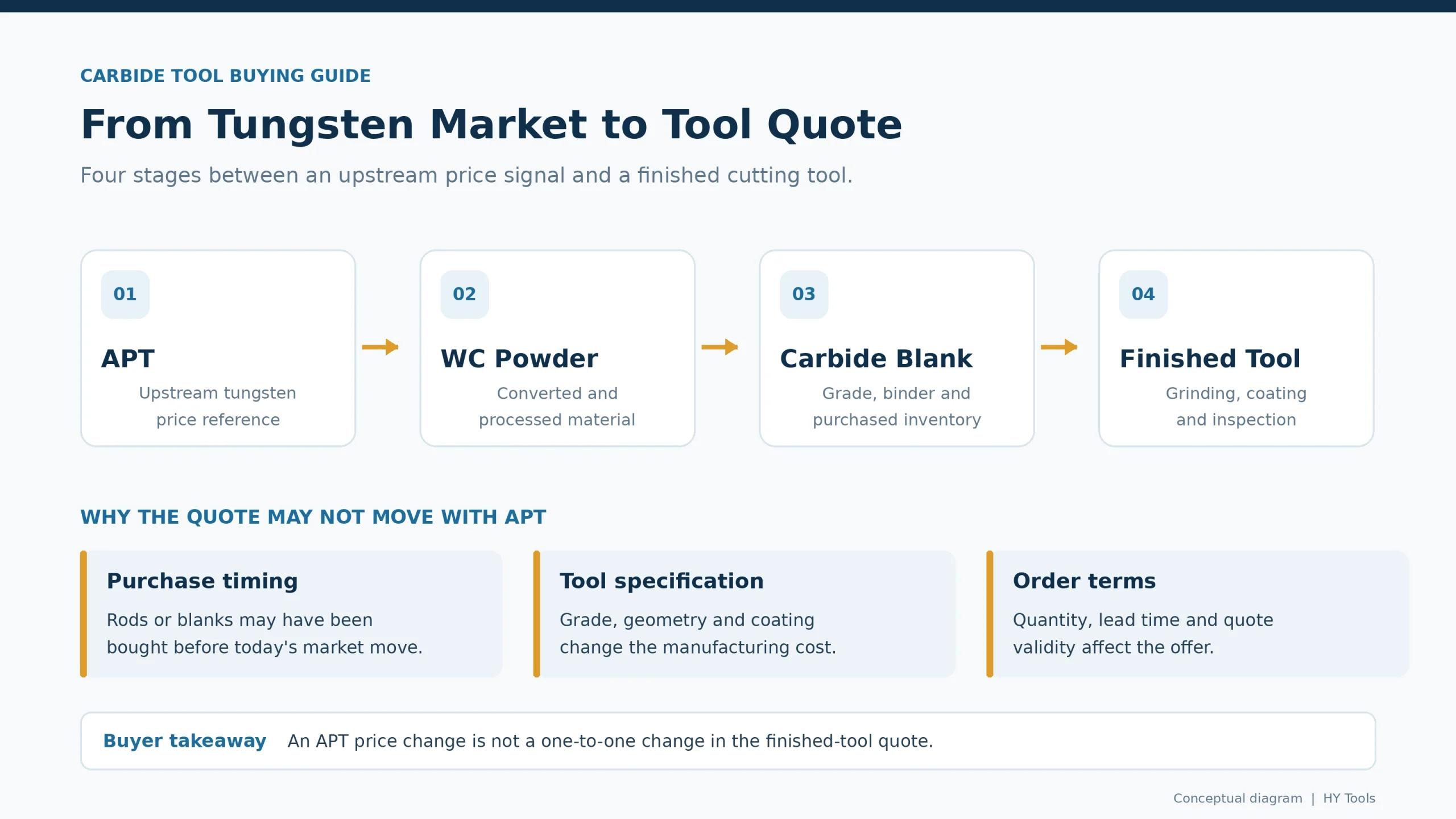
Each stage has its own processing, inventory and delivery cycle. A solid carbide end mill also needs grinding, inspection and, where specified, coating.
Its finished price therefore cannot be calculated by applying this week’s APT price directly to the tool’s weight.
China’s February 2025 measures placed specified tungsten-related products under export controls. Controlled exports require licensing; the measure is not a blanket ban on all tungsten exports.
The official notice identifies the controlled items. For a tool buyer, this is supply-chain context rather than a formula for a finished-tool quotation.
2. Why an APT Price Change Does Not Immediately Change a Tool Quote
Suppose APT falls this week. Why has the quoted price of an Ø10 end mill stayed the same? The manufacturer may still be grinding carbide rods bought earlier, supplying finished stock or purchasing blanks under a separate agreement.
The reverse can also happen when APT rises: existing material inventory may delay a change in the tool price.
Two quotations may also refer to different products. The carbide grade, blank length, cutting geometry, coating and inspection requirements can all differ, even when both suppliers call the tool an “Ø10 four-flute end mill.”
Ask about price validity before placing the order. In a 2026 notice, OSG Canada stated that quotations for special carbide tools would be valid for five days.
That was one supplier’s stated policy, not a standard period for the industry. It shows why buyers should confirm whether a price covers only an immediate order or also planned future releases.
Ask before ordering: Is this price based on available stock, a confirmed production batch or a new material purchase? How long is the quotation valid?
3. Which Tools Deserve Closer Material-Cost Review?
Do not assume that every carbide tool will move by the same percentage. Start with the amount of carbide in the actual design, then consider the work needed to manufacture it.
| Tool type | Material-cost question | Other cost factors |
|---|---|---|
| Large solid carbide end mills | What blank diameter and length are required? | Geometry, grinding time, coating and inspection |
| Solid carbide drills and long-reach tools | How much carbide does the actual blank use? | Coolant holes where applicable, grinding difficulty and production yield |
| Micro tools | Carbide mass is small, but is material the main cost? | Fine-edge grinding, handling, inspection and yield |
| Carbide inserts | Which substrate grade and insert size are specified? | Pressing, sintering, chipbreaker design and coating |
| Indexable cutters and U-drills | Which parts are carbide inserts and which are steel bodies? | Body machining, insert specification and assembly |
Swipe horizontally to compare all columns on mobile.
This is a review framework, not a fixed ranking of future price increases. A large solid carbide end mill may have considerable carbide exposure, while a small cutter can still be expensive to grind.
For a drill, check the actual design in the solid carbide drill range rather than judging by diameter alone. With CNC inserts, compare the specified grade and geometry as well as the unit price.
4. Compare the Same Tool Before Comparing Unit Prices
Two suppliers offer an Ø8 four-flute end mill. One quotation is lower, but its cutting length, corner treatment or substrate differs.
If your customer’s approved cutter is used on stainless steel, the lower unit price alone does not establish an equivalent replacement.
| Confirm | Why it matters |
|---|---|
| Full dimensions and geometry | Diameter alone does not define reach, flute form or corner detail. |
| Grade or agreed substrate reference | Helps keep the approved specification consistent on reorders. |
| Coating and intended workpiece | A similar-looking coating does not confirm the same specification or application match. |
| Quantity per size | Batch size and a mixed-size order may affect unit pricing and MOQ. |
| Quotation validity and lead time | Clarifies when the quoted price and delivery date apply. |
| Packaging and marking | Private-label boxes, labels and laser marking may have separate costs or minimums. |
| Approved sample or model revision | Connects the next shipment to the tool the end customer tested. |
Swipe horizontally to compare all columns on mobile.
You do not need a supplier’s proprietary carbide recipe. You do need an agreed model or grade reference and a clear record of any proposed change.
If the substrate, geometry or coating changes, evaluate it as a new candidate before treating it as a routine reorder.
For a closer look at how flute count, geometry and application affect end mill selection, see our solid carbide end mill selection guide.
5. Reduce Supply Risk Without Filling the Warehouse
Check first: Which sizes sell regularly, and how long does each one actually take to replenish?
A price increase can make a large advance purchase feel sensible. For a reseller, the better starting point is actual sales by SKU and the time needed to replenish each one.
| Sales pattern | Practical approach | Check before ordering |
|---|---|---|
| Regular sellers | Set a modest buffer and review it as demand changes. | Sales rate, demand variation and actual replenishment lead time |
| Occasional sellers | Ask about mixed-size replenishment orders. | MOQ per size, combined order value and delivery frequency |
| Custom or slow-moving tools | Keep the approved specification ready for repeat production. | Drawing revision, grade, coating, sample reference and customer demand |
Swipe horizontally to compare all columns on mobile.
Qualify a second source while stock is still available. A model code, catalog page or clear photos can start the comparison, but critical dimensions and an end-user trial may still be needed.
If staged deliveries are offered, agree on release quantities, dates and pricing in writing.
Three Reactions to Avoid During a Price Swing
- Expecting a finished-tool price to change by the same percentage as one short-term APT move.
- Switching to an untested grade solely to meet a target unit price.
- Buying large quantities of slow-moving sizes because tungsten might rise again.
If a customer needs a replacement outside your usual stocked sizes, our custom cutting tools page shows the types of drawings and requirements that can be reviewed.
Confirm feasibility and lead time for the exact design before promising a delivery date.
6. What to Send When Requesting a Carbide Tool Quote
You can begin with a spreadsheet, current model list or catalog pages. Full machine data helps with application review, but it is not required just to start the conversation.
| Send first | Confirm before approval |
|---|---|
| Tool type and complete size | Critical dimensions, geometry and tolerances |
| Current brand and full model, if replacing one | Which features must match and which may change |
| Workpiece and intended operation | Application details needed to judge suitability |
| Quantity per size and expected buying cycle | MOQ, price validity, lead time and replenishment plan |
| Coating and packaging preference, if known | Agreed coating, marking, label and box specifications |
Swipe horizontally to compare all columns on mobile.
Example inquiry:
Ø8 × 20 mm cutting length × Ø8 shank × 60 mm overall length, four-flute square end mill for 304 stainless steel; 20 pcs for trial, followed by expected monthly replenishment.
Please confirm the proposed coating, MOQ per size, lead time and quotation validity.
If several sizes are involved, send the whole list together. That gives the supplier a chance to review whether a mixed-size trial order or combined shipment is practical.
Frequently Asked Questions
Can I calculate a fair end mill price from today’s APT price?
No direct calculation works across suppliers. The blank’s purchase timing, carbide grade, geometry, manufacturing steps and order quantity also affect the quotation.
Should a carbide end mill become cheaper immediately when APT falls?
Not necessarily. The supplier may be using blanks bought earlier or selling finished stock. Check the quotation basis and validity rather than assuming a one-to-one price movement.
Are large carbide tools always more affected by tungsten prices?
They may contain more carbide, so material exposure deserves attention. The effect on the finished price still depends on the actual blank, grade, geometry and manufacturing work.
Should distributors increase stock when tungsten prices rise?
Review high-turnover specifications and real lead times first. Slow-moving and custom tools need separate decisions based on customer demand.
Make the Next Reorder Easier to Control
A tungsten benchmark can signal pressure in the supply chain, but it cannot replace a tool specification or an inventory plan. Compare quotations for the same cutter, record how long each offer is valid, and keep approved samples linked to your SKUs.
Stock the sizes your customers repeatedly buy; keep a reliable reorder reference for the rest.